


Ten Years of Sword & Kettle Press is a gorgeous new anthology featuring fairy tales, myths, speculative poetry, horror, solarpunk, and sci-fi. The pieces are drawn from Sword & Kettle’s library. Big thanks to the S&K team, Kay Marlow Allen, Naseem Jamnia, and Jude Gardner, for answering my questions!
***
Myna: Tell us about Sword & Kettle Press. What do you publish? How did you get started?
Kay: We are a cooperative publishing house for queer & intersectional speculative literature — but we did not start as any of those things! Back in 2015, I started an indie press from the kitchen table of my college dorm room, mostly because I had been submitting my writing around and wanted to try my hand at publishing. I started out publishing general literary writing, then realized I could lean into my lifelong love of fantasy and speculative lit and focus on that instead.
From there, I narrowed in even further on feminist fantasy and fairy tales, and then brought on Naseem, our former editor Jessie Ulmer, and Jude, who provided different editorial viewpoints. (Also around then I realized I was queer and became disabled, which changed my view of what types of stories I was even qualified to curate.)
As we’ve now become a cooperative press, we’ve taken the opportunity to broaden our focus again — not just fantasy, but also other kinds of speculative writing; not just feminism, but a wider focus on queer and intersectional lit.
Naseem: When Kay brought me and Jessie on, it was to start a foray into a new venture that is now a cornerstone of what we do as a press: mini-chapbooks. Many people are familiar with poetry chapbooks, which are usually anywhere from 20-40 poems. Kay wanted to bring that down to bite-sized, putting together a group of 5 or so poems, a single short story, or a handful of flash pieces, printed on cardstock and hand-bound.
We published seventeen chaps as part of our first, themeless series, Cup & Dagger, and took those lessons into our second series, New Cosmologies, which focused on both retold and original myths and origin stories.
Jude: I was brought on a little bit later than everyone else, and what really struck me about the press both as a submitter and as a team member was the dedication to this idea we’ve been mulling over lately as a team — the idea of “tending to” the works that we publish. As an author, I always felt that my work was going to be loved and respected by the team, no matter what it was. I saw the great care that went into handbinding the mini-chapbooks, and how attentive to detail everyone was throughout the entire process, and now I’m part of that process! Trust me when I tell you that we sometimes spend entire weekly meetings (sometimes multiple!) debating on everything from font choice to page decor to where a piece is situated within our catalogue and, lately, within this anthology.
And as Naseem said, we became known for our mini-chapbooks and, by extension, for publishing in formats that are a bit experimental and don’t fall within the scope of traditional publishing. A lot of our meetings look like, “Hey, what if we tried this?”, and then we try it and are usually pretty pleased with where it goes from there!
Myna: Tell us about your upcoming Anniversary Anthology!
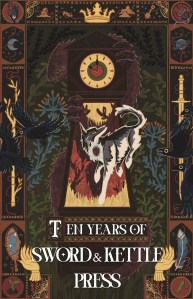
Kay: Called Ten Years of Sword & Kettle Press, our anthology includes selections from the chapbooks and mini-chapbooks we’ve published over the past ten years. It’s a really nice introduction to our publications and showcases a wide range of speculative writing, including fairy tales, myths, speculative poetry, horror, solarpunk, and sci-fi!
Jude: We commissioned a super beautiful cover from Nimaël for this collection that I think really ties it all together! As we talk about a little bit later, the process of re-contextualizing past pieces we’ve published to be newly in conversation with one another has been such a neat experience. I obviously think the world of the writing in this collection, but I’d also like to speak to how incredible it has turned out visually, both with the cover we commissioned and with the amazing layout work done by Naseem!
Naseem: Thank you!! I talk a bit about this later on, but with this anthology, I really wanted to up our layout game. An anthology is more than just a collection of pieces — it’s a curation of works in conversation with one-another. We spent a lot of time thinking about how to make those pieces shine in small decisions, like font (which is actually a huge decision, when you think about it), and also on their physical format on the page.
Many people don’t think about how interacting with a text is determined by what’s physically on the page, and that’s something we consider in our publications.
Myna: How did the anthology come about?
Naseem: We were actually in the middle of discussing another project — a community-oriented one, not a publishing project, that we hope to flesh out and launch in coming years — in April 2025 when we realized that Kay started the press a decade ago, and that we’ve published a lot of amazing work in that time that we wanted to celebrate! Kay immediately came up with the idea to call it a “sampler,” like a sewing sampler, and it spun out from there.
Kay: One thing we wanted to do with this anthology was recontextualize pieces and put different things in conversation with each other. We grouped the pieces together by theme — and Naseem did an amazing job figuring out which things would be meaningful in which places — and then we wrote a short introduction for every piece with our editorial perspectives. For readers who have followed us for a long time and might already own our publications, we thought this would be a nice way to make the anthology still valuable. And new readers who have never read our publications before get to experience a little bit of everything!
Naseem: One thing that’s unique about this anthology is exactly what Kay just mentioned — that each piece is prefaced with an editor introduction. Jude took over discussing the pieces that our previous editor Jessie had worked on in addition to their own pieces, and Kay and I were able to talk about the excerpts we edited. It’s something special to be able to gush about what drew us to accepting a piece and a nice gift for the authors who trust us with their work.
Jude: One of our big inspirations for the design (largely realized thanks to Naseem’s talent with layout!) were medieval tapestries alongside that original idea of the “sampler,” and I think that’s very much reflected in the cover. Those tapestries always told a very vast and winding story, and in a way, this anthology tells the vast and winding story of the press!
Naseem: Not gonna lie, I am living for the layout praises. I lack serious visual artistic talent so creating something that others appreciate visually is very satisfying. That’s one thing I so appreciate about our tiny team — everyone has always been super encouraging of one another to try new things with the press’s backing! I’d never have realized my passion for book design if it hadn’t been for Cup & Dagger and my first attempts at layout.
Myna: If the anniversary anthology had a theme song, what would it be?
Kay: I’ve been noodling on this question for a while, and I feel like the anthology would need its own overture! A little sampling of the different tunes and tones you can expect throughout the book.
Myna: Have there been any surprises along the route to establishing Sword & Kettle Press?
Kay: Basically everything has been a surprise to me, especially the fact that the press I started ten years ago in my dorm room is going stronger than ever. I was also surprised the first year we made enough money that we had to start paying taxes on it — that was a catalyst for me to try to learn more about owning a small business, rather than just having a hobby.
Jude: Sword & Kettle has had a really unique role in my development as a person within the literary industry, and I think I continue to be surprised every time I realize that, hey, I’m a real editor working with a real press to create real projects that I really believe in. As a team, we’ve talked a lot about imposter syndrome and the trajectory of growth and about how, the more you know, the more you begin to doubt yourself. I’m super grateful to have gotten the chance to become part of this team, and it continues to surprise me that we keep putting out beautiful stories and poetry and that they keep being so well received by a community that we’ve authentically and meaningfully cultivated!
Naseem: Honestly, I’m surprised Kay and Jude have tolerated my chaos for as long as they have!! And on a more serious note, I’ll always be amazed at the work that comes through our inbox — I feel so lucky whenever people think of us when sending out their work — and the support we get from the community when we crowdfund.
Kay: Naseem, you keep us on track! And I have to echo that the support and interest we receive from our writers and readers is really amazing.
Myna: What does the press look for when choosing projects?
Naseem: For me personally, I’m always looking to champion racialized voices. It’s important to me that S&K becomes a place where racialized authors think to sub, and that we consistently publish work by racialized authors, especially those who lie at the intersections. I especially love when an author (racialized or not) draws from their cultural background to inform the work they’re submitting. Beyond that, I’m always interested in projects that deal with colonization in some way, especially as someone with a postcolonial academic background.
I can’t abide submissions that reinforce harmful notions. Disability being erased by magic or technology, ableism excused by “the times,” racialized people subjected to or causing violence, queerness that is maligned in a setting where that’s an authorial choice—I am not a good fit for these stories, and frankly, neither is the rest of the team.
Jude: I don’t really have anything to add to what Naseem has already said so well, but alongside that I will add that I’ve noticed that we’ve recently been drawn to authentic explorations of disability and examinations of longstanding narratives of violence in a lot of the works that we’ve published. I don’t think that this has been intentional, necessarily, but it has felt very important in recent years and I absolutely love getting the chance to tell such stories.
Myna: How do you acquire your projects? What’s the process like?
Naseem: Our mini-chaps come out of specific calls, and we’ve solicited our longer projects, although I think we’re all eager to consider how to move into having regular submission periods a la Corvid Queen. Part of the next stage!
Jude: This might veer a little off-topic for the question, but I’d like to bring up our decision-making process for these specific calls, because I think it really speaks to how we function as a team. I’m fairly certain that the ideas for the New Cosmologies series and for Ten Years of Sword & Kettle both came from someone tossing out a thought at random, and the rest of us jumping on board immediately. I don’t want to talk us up too much (but really, I do!), but our brainstorming sessions are quite legendary!
Myna: I love that you offer resources and consulting for other lit mags. What sorts of topics can you help with?
Kay: We haven’t really had anyone take us up on our consulting offer yet, but as an indie, DIY press, we’ve had to learn a lot about logistics over the past ten years. I think we’re particularly well-suited to talk about crowdfunding, running an online shop, finding low-cost tech, and varying income streams.
One project we have in the works is actually an incubator program for developing lit mags to help pass on even more of the knowledge we’ve acquired!
Naseem: That was actually the community-oriented program we were discussing when the anthology idea burst through like the Kool-Aid Man. We’re thinking that teaming up with other small presses or longer-running magazines, even for one-off lessons, might be a really cool opportunity for community building.
Myna: I’d love to know more about Corvid Queen!
Kay: Corvid Queen is our long-running digital magazine of fairy tales, folklore, and myths! We publish a new piece of writing (approximately) every Friday, and have collected over 250 pieces on the site. It’s free to read, and we offer a curated index of stories focusing on genres, cultural roots, and common motifs.
Naseem: With our recent press transitions, our new slant for Corvid Queen is “fairy tales from the margins”!
Jude: One of the things that I think makes Corvid Queen is the way that each piece is categorized through these common motifs, which I think sets the stage for the work that is being done in the anthology and additionally encourages all of these pieces to also exist in conversation with one another! Also, the site is just gorgeous to click through–if you read a story and click on a tag at the end of it, you could really tumble down a rabbit hole for a good few hours.
Myna: Tell us about your roles. What do each of you do?
Kay: As we transition to a worker-owned cooperative, that’s actually something we’re figuring out! Right now, I manage Corvid Queen and the operations side of the press — keeping financial records, running our online shop, things like that.
Jude: I started with the press as an author, and then became the social media manager, and now I’m an editor! I have a background in social media management for bookstores and independent presses, but I’ve become super fatigued with the online world, and as a press we decided to move away from these platforms. So now, I work directly on editing and production, especially with the poetry pieces, and I also handle most of the outreach to share things like our press kit for our recent Kickstarter campaign. As Kay said, though, our roles are currently in flux, which has been a neat opportunity to evaluate what we each currently bring to the table and what we would like to be doing in the future!
Naseem: As I mentioned earlier, Kay brought me on to be an editor, and since then, I sometimes dip into project management (like with our anthology project) and always am our notetaker (my ADHD needs to have a task during meetings). I only became our official layout designer with the New Cosmologies series!
Myna: For each of you, please tell us about your own writing! Where can we read your work?
Kay: I mainly write roleplaying games! I have a number of solo games available, as well as a duet letter-writing game called Your Friend in Witchcraft. Digital downloads of my games are available through itch.io, and print copies of Your Friend in Witchcraft are available through Indie Press Revolution (or potentially at your local game store)!
Jude: I’m currently reshaping a lot of my identity as a writer, so this question is a little messy for me right now! I’m working to incorporate elements of photography and mixed media artwork into my poetry and prose, and am currently in the middle of quite a few projects, including a typewritten zine that features collage artwork and explores the gothic elements of my rural Midwestern roots. Updates can be found on my website and on my Instagram!
Naseem: If you couldn’t tell from my answers, I’m a verbose motherfucker. My debut slice-of-life novella, The Bruising of Qilwa, follows a traumatized nonbinary refugee healer with taboo blood magic in a queernormative Persianate world and came out from Tachyon Publications in 2022.
My debut middle-grade fungal horror novel, The Glade, following an autistic aspec Iranian American tween entering an eerie dreamworld to save her best friend, released in 2025 from Aladdin, an imprint of Simon & Schuster. (More info on my website!)
I operate mainly in inclusive spec fic and explore the intersectional experiences of being queer and trans, neurodivergent, part of a racialized diaspora, and a child to Iranian immigrants. I’ve got a newsletter that I send out every-other week; one focuses on craft and the industry, and the other is a personal essay.
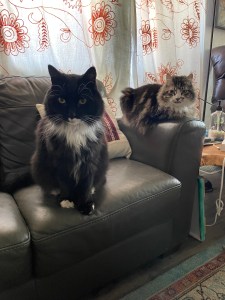
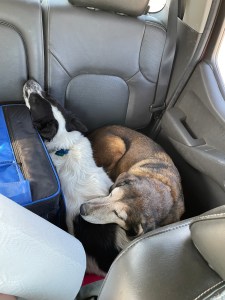
Myna: Tell us about your non-writing activities! Hobbies? Pets? Show us pictures!
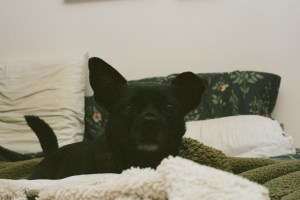
Kay: I’m in what I’ve been calling my “anarchist tradwife” era — I’m super into sewing, gardening, and cooking right now! I also do read a lot of fantasy and sci-fi for fun, and I love a good Switch game. I have a wonderful doggie named Paul who keeps me company while I work from home 🙂
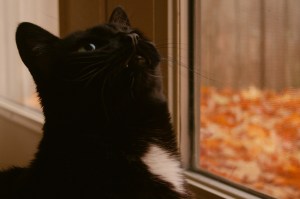
Jude: I’m also getting into gardening this year! This is my first year with some outdoor green space to call my own, and I’m learning to tend to my little crop of veggies and herbs! Outside of that, I’m in school studying to be an archivist or curator and I also enjoy reading (especially speculative fiction, fantasy, and sci-fi), exploring abandoned buildings (and taking very liminal-stye photographs), and I’ve recently picked piano back up after abandoning it for many years. I also have a very picky, very spoiled cat named Bunny with my partner, and we are both absolutely devoted to her every whim.
Naseem: We’re all gardeners—my spouse usually does the heavy lifting, and I maintain during his field season! (Heavy lifting was an unintentional pun; we also both do strength training.) We’ve got two dogs and two cats, who keep us very busy. I’m a big gamer — like Kay, the Switch is my platform of choice, though I’m currently playing Expedition 33 on the PS5 and am totally hooked. I’m a huge fan of board games, too—my favorites are Castles of Burgundy and Isle of Cats! I’m also a pro-library activist (so I spent a lot of time yelling at my local library trustees), and I’m in a nonfiction book club with some of my fellows. (We’re the leftists election commercials tell you to fear.)
Myna: What do you wish I’d asked?
Naseem: “What can you tell us about layout, Naseem?” Why, I’m so glad you asked! One thing I’m really passionate about is the ways in which we as a press can bring queerness beyond the page. I love the idea that a cooperative “queers” a business. In a similar vein, I’m trying hard to “queer” what a book means during the layout process. I think we already began this process when Kay first introduced the idea of mini-chapbooks, because it changes expectations of what a “book” means, from the physical construction and hand-bound format to its contents. Starting with New Cosmologies, I began to question what else we expect a “book” to contain, so we added some simple images throughout. With the anniversary anthology, I took it a step further — interrupting text with images, adding photographs, debating where certain elements should be on a page and how they can extend off the page. I cannot wait to learn more about design to further incorporate these ideas for future projects!
Myna: What’s next for Sword & Kettle?
Naseem: We’ve loosely discussed re-releasing the two collections Kay published before expanding the press, T.R. North’s Of Witches and Wolves: New Tales from Old Traditions and Amanda Crum’s Cinders and Glass. We’ve also discussed the possibility of branching into speculative nonfiction! But I think the biggest thing is that, now that we’re transitioning to a worker-owned cooperative, we need to hammer out our policies so we can bring on some new folks!! Hopefully, we can coincide that with a new mini-chapbook project 🙂
***
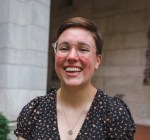
Kay Marlow Allen is an award-winning game designer and publisher who lives in Massachusetts with their partner and dog. They like playing pretend, telling stories, making things with their hands, and imagining what a better world might be like. Find their duet letter-writing game Your Friend in Witchcraft at Indie Press Revolution or your friendly local game store.

Naseem Jamnia writes inclusive speculative fiction for adults, teens, and kids. They’re the author of fantasy novella The Bruising of Qilwa, which was a finalist for the IAFA Crawford, Locus, and World Fantasy awards, and middle-grade fungal horror The Glade. They teach through organizations like Tin House, Clarion West, and others, and are faculty at the low-residency creative writing MFA at the University of Nevada, Reno, at Lake Tahoe. An Iranian Chicagoan, former neuroscientist, and pro-library activist, Naseem currently lives outside Reno with their geologist husband and four furred creatures. Learn more and join their newsletter at NaseemWrites.com.
Jude Gardner is an experimental poet, author, and artist combining mediums to create exploratory works. Their work has appeared under a different name in Maudlin House, Ghost Orchid Press, and Eternal Haunted Summer, and is often inspired by the Midwestern gothic genre, old magic, and the allure of the strange in the ordinary. Jude is the author of two poetry collections, two chapbooks, and a novella. They currently reside in Indianapolis with their partner and their extremely spoiled cat, Bunny, and are studying to become an archivist.
Find Jude on Instagram.

