

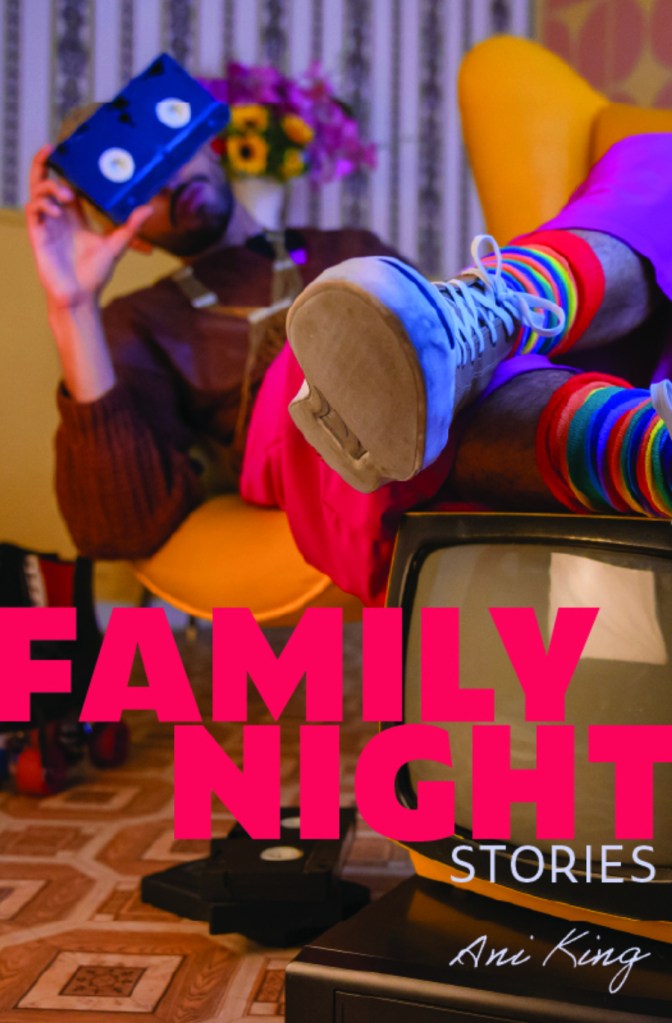
Ani King’s new collection, Family Night, was released in October from Mason Jar Press. Ani’s writing is a gorgeous blend of literary and speculative, and I think readers will love it.
Huge thanks to Ani for answering my questions!
***
Myna: Tell us about Family Night! What themes do you explore?
Ani: While the primary theme in Family Night is definitely family connection in various states, this is ultimately a pretty queer book and so there are also explorations of class, gender, parenthood, childhood through that lens. As well, I think there is a distinct sense of “otherness” throughout the pieces. I surprised myself a bit when ordering all these stories to see that, in some ways, this is also a book about grief. It’s probably my age; being in my late forties I think I am more deeply aware of my own mortality. I also discovered as a part of the story ordering process that I write a lot of stories about mothers or motherhood as a role, and I am fascinated by how little grace mothers are given when they step at all outside of their assigned role and the movements they are supposed to inhabit. There are mothers in this book getting it incredibly wrong, being young and dumb and making mistakes, or doing their best and not hitting the mark, and not one of them would be considered as remarkable if they were fathers instead.
I am fascinated by how little grace mothers are given when they step at all outside of their assigned role
Myna: Who are your characters? Do you have a favorite? Was one particularly easy (or hard) to write?
Ani: My characters are mostly hot mess queers, even if it’s not explicit on the page. Everyone is looking to love or be loved, and this includes yearning teens from the nineties, Sisyphus with his addiction issues and his tired-of-this-shit cowboy boyfriend, as well the Minotaur and their wife, and Pearl, the lobster woman who’s facing her first molt alone after losing her mother. It’s hard for me to say I have a favorite, because all of my characters are my favorites while I’m writing them. I think I find the hot mess queer teens the easiest to write, probably because I was such a shit show at that age and so many details are seared into my brain. I think the hardest characters for me to write are the ones who are established and settled in some way, because it requires a little more digging to find their spark, or the thing that lights them up and makes them interesting in a story, and a lot of that digging is really the passive act of letting the character make their self and story known.
It’s hard for me to say I have a favorite, because all of my characters are my favorites while I’m writing them.
Myna: When a reader finishes the last word in the collection, what emotion will they be feeling?
Ani: Hopefully, introspective, maybe a little hungry, probably a bit dehydrated from some of the crying. In all seriousness, I end the book with an end of the world story, which ends with singing, because even though there is a fair amount of grief and loss, there are also moments of profound connection between imperfect people: in “Feels Like Rain” two men who are down on their luck find each other outside an ALDI, in “Kitchen Dancing” a child connects with their mother and stepfather over stew and a layered conversation about gender. There are queer people experiencing sorrow, but queerness is not a source of sorrow in these pieces, so I also hope my readers find a very specific satisfaction in trans- and queerness not being used as a traumatic device.
Myna: How did Family Night come about?
Ani: This story is the best evidence of the importance of a website contact form! Heather Rounds with Mason Jar Press reached out after reading “Peonies” (shout out and massive thank you to Wigleaf for giving this one its first home!) to see if I had anything in the works that I might be interested in sending for them to look at. I technically did have a chapbook I’d cobbled together to submit, but I was also in the process of buying a new house, selling the old one, then moving, so I had pretty much shelved it for the time being. I said yes though and emailed over about eighty pages for review. They liked what I sent, I liked their approach, the people involved, and the contract, so the rest is history!
In terms of writing process, most of the stories were already published at the time that we started talking, so I also started hoarding some of my newer favorites as they were finished for the collection.
Myna: I love the playlists on your website. Tell us about them! If your collection had a theme song, what would it be?
Ani: camry by Max Garcia Conover – whether the stories are speculative or not, there’s always a sense of trying to make it through, to make shit work, imperfectly and sometimes impossibly.
Myna: Did you find any surprises or problems while writing or publishing this book?
Ani: Problems: no, thankfully! I think the one thing that ended up surprising me is how much I’ve written about grief, without necessarily realizing it as I was writing. There were themes I felt highly aware of as the collection was coming together, but that one was so prominent that I was also surprised to be surprised.
Myna: How would you describe your writing style, in general?
Ani: Lean, lyrical, experimental, rule breaking, and blurring the line between poetry and prose fairly frequently. I also love to build stories with accessible language and find ways to make the words most of us know and use feel new in those configurations. I love a long, meaty, challenging word as much as any writer, but I’ve always loved the way that Ursula K. Le Guin for example could tell these fantastically layered and personal stories and do it in a way where she teaches you the language of that world, and how to read the story, by making such intentional-feeling choices with everyday language.
Myna: What’s your favorite thing about writing?
Ani: Playing! I love the moment where writing feels like creative play, like mental finger painting, like finding the vibe so it’s not work, it’s messing around with tinker toys, it’s climbing monkey bars, it’s sprinting across the yard just because it feels good.
Myna: How do you stay motivated?
Ani: Sometimes I don’t. The reality is there are times when ADHD, seasonal depression, or life in general will win and I don’t have the capacity or interest in writing. This is usually when I try to do the admin stuff: website updates, social media and promo, writing reviews for other people—things that are still a part of the authorial and writing community process. At the moment, I’m both recovering from some pretty intense burnout, and I think I am a little depleted after putting Family Night together. I also tend to have cycles in my writing process that correlate to other mental health cycles, so after two-three years of what felt like constant writing, tons of publishing, I’m finding that I need to fill back up, if I want to get anything out.
Myna: Tell us about a recent accomplishment or share some happy news with us!
Ani: I’m very excited to be co-teaching my very first writing workshop with Allison Field Bell as a part of her new venture, Field Works Writing, and it’s focused on breaking cardinal writing rules with intention. We’re covering adverbs and adjectives, punctuation, and show versus tell and it has been an absolute blast!
Myna: Do you have other books or stories you’d like to mention?
Ani: I’d love to share a couple of Deer Boy and Horsegirl stories, which are two projects I’m always working on a little bit in the background, and are such passion projects, in part because they are where I really started to explore queerness and neurodivergence and disability together.
“Deer Run” in Broad Ripple Review
“Nervous Thing” in Pithead Chapel
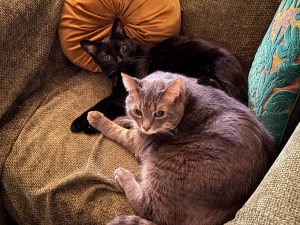
Myna: Do you have a pet, or other non-writing hobbies/activities? Show us a picture!
Ani: I have two perfect and lovely older cats, plus so many hobbies, including but not limited to knitting, crocheting, sewing, drawing, painting, and taking way too many pictures of my cats. I am definitely a person who has some intense interests! My cats, as pictured, are the opposite of intense, unless they think it is food time.
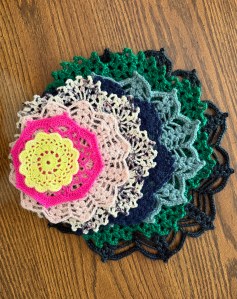
Myna: Do you have a question you’d like me to ask the next person I interview? What things are you curious about in other writers or editors?
Ani: What are non-writing things that you do as part of practicing your craft? What is the most recent flash story you’ve read and loved? (My answer to this is “Prom Queen in a Podunk Town” by Mina Thorsen, published by Flash Frog.
Myna: What’s next for you?
Ani: I recently went to Stratford, Connecticut, as a lordship house resident and had such a restorative, fulfilling time, as well as a bit of a breakthrough on where to take the Deer Boy stories project, so I’m going to be doing research that includes visiting the Oldsmobile museum here in Lansing, Michigan, and reading historical accounts of being a queer man in the 1950s. (Huge shout out to Adrian and Michael!) Hopefully I’ll also be writing other things, but I have learned not to push or apply pressure to myself when it comes to drafting new work, or it only takes longer for the inspiration to come.
***
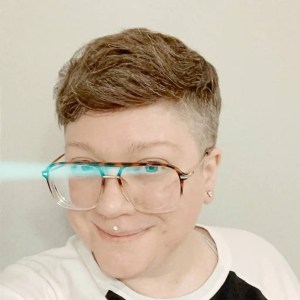
Ani King (they/them) is a queer, gender non-compliant writer and artist from Michigan. They are the first place winner of the 2024 Blue Frog Annual Flash Fiction Contest, a SmokeLong Grand Micro Competition 2023 finalist, a SmokeLong Emerging Writer Fellow 2025, and a 2026 Lordship House Fellow. Ani has work featured in SmokeLong Quarterly Review, Split Lip Magazine, Fractured Lit, Exposition Review, Wigleaf, and other terrific publications. As well, they are a Monarch Queer Literary Award recipient, with work on the Wigleaf Top 50 Long List, and in Best Small Fictions 2025 and Best Microfiction 2026. Ani’s first full length flash collection, Family Night, is available now from Mason Jar Press.
Order Family Night direct from Mason Jar Press, on sale now.

