


Dave Alcock’s new flash collection, Things Like This, was recently released by Arroyo Seco press. The early reviews are brilliant! I’m looking forward to diving into the book. Thanks to Dave for answering my questions!
***
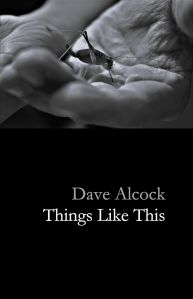
Myna: Tell us about Things Like This! Who are your characters? What themes do you explore?
Dave: Things Like This is a collection of my flash fictions that have been written and published in journals over the last ten years. All of these cohere around the idea that seeing smallness is a mistake and that significance is everywhere. The stories are about ordinary people and everyday life, and they feature such things as childhood accidents, animal sightings, bad dreams, dead-end jobs, village playgroups, and difficult phone calls.
Commonplace dramas of this kind (despite their familiarity to so many of us and the myriad recognitions they can lead to) are sometimes easily dismissed, considered banal and seen as happenings we wouldn’t write about or read about.
But in Things Like This, events of this kind become lenses that reveal a wide range of universal human themes, from abandonment, vulnerability, transitoriness and the fear of mortality, to relational discord or harmony, the competition between different valuations of masculinity, or the loss and restoration of identity or self-belief.
Spanning and binding the collection is my view that by attending patiently, actively, and compassionately to the deceptively minor changes of our own and others’ apparently quotidian lives, we can more effectively recognize their value, and, in doing so, more deeply appreciate their “enoughness”.
Myna: Your collection has some stellar blurbs. I was especially moved by John Brantingham’s observation that your writing finds “those moments between the moments, which constitutes most of our lives…” Is this focus something you deliberately pursue in your work? How would you describe your writing style?
Dave: This concept is such a powerful one. At the time I received John’s endorsement of Things Like This a few months ago, I’d known him for about ten years, and, since the beginning of that time, I’d been confident that he understood exactly what in my writing I was trying to do. It has always been my intention in the stories of Things Like This, to dramatize deceptively static but essentially changeful moments from ordinary people’s lives. My narratives and the awakenings they re-create aren’t fantastical or sensational but they’re always substantial (at least, that’s how they appear to me).
When John used to talk or write about the importance of registering “those moments between moments”, he was talking about the need that there is to accept all parts of our lives, including those that are negatively judged when measured against hegemonic scales of value. For John, this was a big deal, because he understood that the exclusions and erasures of personal or collective experience are psychologically self-destructive, politically dehumanizing, culturally and socially unrepresentative, and, on all levels, inadequate.
His world view (which I share) is one which recognizes the importance of the marginal, and literature (including flash – perhaps especially flash) is particularly well-equipped to demonstrate this claim through its portrayals of realities in which the truth enters through unlikely doors. In my own stories I like to think that startling and exotic meanings emerge through humdrum subject matter, believable changes through bitty or unfinished dramatic arcs, crystalline visions through gaps in dialogue or action, poetic shocks through quiet and commonplace words.
This focus on the liminal isn’t new to me; I think that many of us learn to see in this way when we’re young. I remember stopping once, as a boy, for example, at a murky riverside puddle with my grandfather. And I remember seeing plainly that nothing was there. He knelt and lowered his hand into the water, then, seconds later, brought it out with a newt. The softness and attentiveness that my grandfather showed me beside that muddy pool is exactly what many writers bring to their work: when sitting with our memories, or recalling scenic details, or doing field work, observing, recording, composing, placing lines or passages in our stories.
For me, in my writing, these elements (and the small forgotten occasions they’re linked with) – what John called the moments between the moments – are the silted waters in which the unexpected often resides.
It means a lot to me that John saw this intention in my work and his marvelous ability to articulate, illustrate, and champion this artistic tendency – in his own writing, as well as in the work of those he encouraged – is one of the many things that those who loved him will miss.
Myna: When a reader finishes the last word in the collection, what emotion will they be feeling?
Dave: As the book ends, I hope that readers will feel a rare, fragile, and transitory sense of wholeness. The protagonist of the final story has, at this point, moved from a state of loss – of possibility, wonder, maybe even gratitude – to a state of restoration and I hope that readers will have been taken on a similar journey.
As well as this, I expect readers will feel a sense of relief, as many of the stories in Things Like This end more abruptly and deliver grittier, more unsettling conclusions.
Answering this question, thinking about the book’s ending, leads me to reflect on its overall structure and its unifying theme. Things Like This begins with three micros, two of which feature isolated and neglected children, and ends with a story about a family group, and this contrast reflects the book’s preoccupation with the importance of connection – to our own easily disregarded lives, to our communities, and to the million-petalled worlds we occupy.
When the final story ends, a formerly disenchanted protagonist has been reconnected with the spectacular, non-materialistic wealth that surrounds them but which, for some time, they’ve been unable to see.
So realistic security, connection, recovery, and contentment – however evanescent – are all emotions that I hope the reader will experience as they finish the book.
Myna: How did this collection come about?
Dave: Things Like This is the result of an experiment based on a hunch. As I said earlier, it’s taken me ten years to put it together and when I started I didn’t have a clear concept – let alone a plan – for a book. I did, however, have an underlying idea.
I’m not an especially creative thinker – I’d say I’m more journalistic in my approach – and I wanted to write stories that were very honest and truthful, and which had, therefore, to some large extent, to be based on direct or indirect personal experience. Henry David Thoreau once said that “the mass of men lead lives of quiet desperation”, and, whilst writing Things Like This, I’ve often thought about those similarly troubling lines of Thomas Gray’s (from his “Elegy Written in a Country Churchyard”) about “mute inglorious Miltons”, the unacknowledged figures of the past, who (Gray sadly observes) like neglected flowers, were never noticed or listened to and “blushed unseen”.
To some extent, my own determination to write stories inspired by ordinary life is motivated by an almost political refusal to accept the obliterating fate that Thoreau and Gray describe here, and which, I agree, entombs so much of the experience and insight that common people could, in more inclusive circumstances, constructively and artistically share.
My own life has been exceedingly commonplace; the son of schoolteachers, I’ve spent most of it working as a schoolteacher myself, living in a provincial town in the country where I was born and have always lived.
And yet, ten years ago, at the age of 40, I was starting to feel that my life was (to some degree) complete. I’d learned things along the way, and I began to wonder if the fractured dramas and breakthroughs of my own experience could be fictionalized and orchestrated to produce some sort of multi-protagonistic and tessellated story of self-formation – a book that was personal but also universal.
At the same time, I happened upon the flash fictional form (which, of course, I’ve come to learn a great deal more about since).
This form, because of its brevity, lends itself well to portrayal of the kinds of interrupted or partial awakenings that I wanted to dramatize.
It’s also typically democratic, frequently exploring plain or demotic language or prosaic subject matter to produce dazzling literary effects. My subject matter was deceptively uneventful real life and in flash fiction I had found my medium. Everything I wrote over the next ten years was unified by the same original intention. Eventually, it became obvious to me that there was a book – about incremental and total growth through experience of minor events – and that’s when Things Like This began finally to crystallize.
Myna: How do you stay motivated?
Dave: I sometimes think that one of the best things we can do as writers, to keep ourselves motivated, is just to sit there with a marvelous piece of writing in front of us (something great by another author) and allow ourselves to be flabbergasted. To be enriched and rewarded by what we read. To chuckle or laugh or feel the descendance of the world sadness that we encounter in the very best books.
My frequent amazement at what other writers have done has refired my personal determination to produce literary art time and time again. Writers use a vast toolbox of literary and linguistic resources to create sensuously, emotionally, conceptually transporting artefacts. Even the fact that these things are created is a reminder of how unsurpassably precious the human experience is. And great writing rubs off on us. It enables us to name and comprehend – and value and appreciate – the bits and pieces of our own lives that we might otherwise neglect.
Having a positive regard for great writing and reminding myself of it by regularly reading fabulous work is, as much as anything, what keeps me focused.
Myna: Do you have other books or stories you’d like to mention?
Dave: It would be great if you could include a link to a piece of mine that was published a few years ago in the Cabinet of Heed called “Sun Squares”. It’s about bringing up children and how quickly our experiences come and go. We’re told this a lot, of course – “It’ll be gone in the blink of an eye” – but I wonder sometimes how well we really allow this understanding to settle. “Sun Squares” is about someone seeing this and momentarily accepting it, and it’s one of several stories that explore parenthood and impermanence in Things Like This.
***
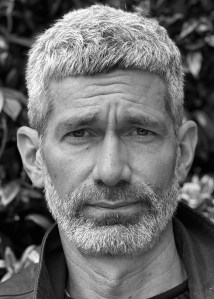
Dave Alcock is a writer based in Devon, England. His short forms have appeared in a range of online journals that includes Every Day Fiction, Flash Frontier, MacQueen’s Quinterly, The Journal of Radical Wonder, and The Dribble Drabble Review. His work has been nominated for Best Microfiction, Best Small Fictions, and Best of the Net. Things Like This is his debut.
Find Dave on Facebook

