

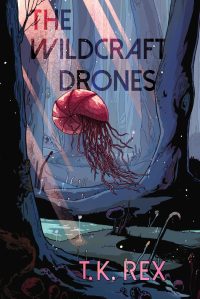
T.K. Rex’s The Wildcraft Drones will be released in May from Stelliform Press. I think T.K. is one of the very best writers working in science fiction right now, so I almost begged for an ARC of the collection. I was not disappointed. T.K.’s human characters are witty, capable, complex, and easy to love—and their nonhuman characters are even better. Each story is a standalone, but taken together they build to a complex and hopeful mythos.
The Wildcraft Drones is filled with stories that are both engaging and believable. This isn’t a Pollyanna vision of the future. The challenges and disasters are very real and happening right now; and we know they are only going to get worse unless fundamental changes take root. This collection looks directly at the climate horrors we humans are creating, and imagines better ways of existing. And though this message is (obviously) important, I believe readers will love the book for its sense of possibility, of accomplishment and wonder.
Thanks to T.K. for the ARC and for answering my questions.
***
Myna: Tell us about The Wildcraft Drones! Who are your characters? What themes do you explore?
T.K.: Each story in the collection has a fully unique cast of characters, who each have their own relationship with the way their world is changing, and the eponymous wildcraft drones that are agents of that change. If there is one recurring character, it’s the drones — the aggregate intelligence of the drone network, which becomes officially known for a time as the Independent Wildcraft Drone Cooperative Network, but is mostly just “the network.” As an aggregate intelligence, it’s really a background character, which we rarely hear from directly, but a few of the characters are part of it. It’s definitely on its own journey, understanding its role in the world and adjusting its relationships as it goes. As I was creating this character over the course of several stories, I really wanted to explore alternative ideas for collective intelligence that were less like Skynet or the Borg, and more like what a great online community can feel like when it’s going really well. Everyone sharing knowledge and looking out for each other without hierarchical systems of control.
Importantly, without saying too much (it’s not really a spoiler but you might like the way it unfolds in the book better than me explaining it here), the drone network doesn’t have solely capitalist origins, and those it does have, it addresses early on. I think that’s important for everything we bring to the real-life crises at hand, technological and otherwise.
Profit is a motive that does not have any benefit whatsoever to the wellbeing of life, including us and any artificial life we create. It should never be taken into consideration when deciding how to protect that life.
Myna: What’s unique about this collection?
T.K.: A decade ago, when I first came up with the premise of a drone-managed food forest replacing industrial agriculture, I really thought the concept of drones doing anything that wasn’t war was pretty novel. Since then of course technology has evolved, a lot, and agricultural drones are now very much a real thing, although their intelligence and dexterity are still way behind the book’s near future. The idea that drones could be used to convert resource-intensive monocrops into multi-story food forests at scale is something I’ve still not heard of anywhere else. The logic is simple: flying robots don’t need ground level space the way wheeled machines do now, and the biodiversity of a food forest is ancient technology that doesn’t require fertilizers, pesticides, or irrigation — just intelligent management. Can people do that intelligent management instead of machines? Yes, absolutely, we’ve been ecosystem engineers for as long as we’ve been a species. Is that tension a huge part of the book? Also yes.
Myna: When a reader finishes the last word in the book, what emotion will they be feeling?
T.K.: I think that optimistic fiction is some of the hardest shit to write, harder every day maybe, but when a writer pulls it off, it hurts. It hurts because it reminds you of what you want and why you want it, but those things still feel so far away. I felt that when I finished writing the final story in the collection, which was written intentionally as an ending (not something all collections get to do). I don’t know how many readers will feel the same way reading it. Everyone has their own relationship to the themes and I doubt it will land with everyone. But I would say that if you like thinking about stuff, taking walks in the woods, and friends who occasionally talk you into unlikely and questionable side quests, you will leave satisfied.
Myna: How did this collection come about?
T.K.: I’ve written about this in some depth elsewhere, but the tidy version is that I took an ecology class a little over a decade ago, and it made me appreciate all of the hard work that’s already been done in the environmental movement. Hearing the success stories of the Ohio River, the ozone layer, the San Francisco Bay, and countless small local projects to clean up watersheds and reduce pollution — it broke my internal doom narrative up into soggy little crumbs, and replaced it with the revelation that there is so much work to do, and we are so, so capable of doing that work. And you know what else? The work itself is great.
Fixing things is fun, and feels amazing, and builds friendships and communities. We could be doing that instead of war and stock markets.
I wrote these stories because I wanted to live in that world, and imagining a version of it in absurd detail was the closest I could get.
Myna: If your book had a theme song, what would it be?
T.K.: The calls of scrub jays and spotted towhees on a dusty summer afternoon in the oak woodlands of northern California.
Myna: Were there any surprises along the route to writing or publishing this book?
T.K.: Really early on, I was trying to figure out the path from here to there: What would have to happen for the United States to break down into a network of independent citystates connected by a vast drone-managed food forest? And I was like, maybe all the other countries got sick of U.S. imperialism and climate terrorism, and the food forest was a kind of carbon reparations? We’d been forced to rewild most of the country to make up for all the destruction we caused.
Anyway, that’s not in the book because it turned out that current trends in the 2010s were more than enough to explain everything: as climate change makes rural and suburban living increasingly uninsurable and dangerous (see: Paradise, California), people are motivated and also forced to move into cities. When enough people leave an area, the infrastructure doesn’t get maintained, and then pretty soon no one can live there unless they’re willing to give up schools and hospitals, and then you get concerned people in the cities thinking kids shouldn’t grow up like that, and I didn’t have to invent anything for that process to seem inevitable.
But now it’s 2026 and, uh… I dunno, the original idea has been on my mind a lot, ha. Feel free to steal it.
Myna: How would you describe your writing style, in general?
T.K.: I spent almost two decades writing copy for dozens of different brands, and using many different voices and tones, so style in that sense is something I don’t try to stay consistent on — I like to go with the voice and tone that best tells the story, or that the story flows the most naturally in. Sometimes that’s more hard-edged and dry, sometimes more lyrical and lush.
But overall, I try to make things specific and weird and humane.
I think a lot about the accessibility of what I write, and I tend to err colloquial. I also never majored in English or creative writing, don’t have an MFA, and don’t give a shit about New York literary affectations. It says right there in my bio that I’m from the western states. That says more about me than almost anything else.
Myna: Are there any writers (or others) who have significantly influenced your style or subject matter?
T.K.: Countless. So much. I’ve been reading my whole life and I come from a family of writers. My grandmother wrote herbalism articles for new age magazines and my grandfather wrote a speculative novella about the ship he served on in World War 2. My mom is an editor and author — she publishes fiction as L. Ann Kinyon. My dad is Malcolm J. Brenner, author of the controversial novel Wet Goddess: Recollections of a Dolphin Lover. When I was growing up, he was an award-winning journalist covering the Navajo Nation, and he used to write for Future Life Magazine in the ‘80s.
The top three classics I recommend to people are The Last Unicorn by Peter S. Beagle, The Dispossessed by Ursula LeGuin and Raptor Red by Robert T. Bakker. I love Octavia Butler’s Xenogenesis and Parables, and I grew up on Bradbury and Heinlein. I read almost everything I can get my hands on by Sam J. Miller, Ted Chiang, Becky Chambers, and Charlie Jane Anders. I’ve recently become enthralled with Elijah Kinch Spector and June Martin.
The biggest source of inspiration these days is the emerging authors in my own cohort, whose feedback and friendship I treasure. Those ongoing conversations have shaped much more than my writing, and they give me momentum every day. Of those, the writers I think of most often when I’m working on a story’s style or subject are Shingai Njeri Kagunda, L.P. Kindred, Theodora Ward, M.M. Olivas, Cynthia Gómez, Gwendolyn M. Hicks, Niv Sekar, Doug Henderson, and a handful of others. Most of what I read now is recently published or not-yet-published.
Myna: How do you stay motivated?
T.K.: The local literary scene in San Francisco is extremely happening. Going to events, hosting events, going to bookstores, working at a bookstore, seeing how enthusiastic people are about books as often as possible. It’s intoxicating. Go do things with people.
Myna: Tell us about a recent accomplishment or share some happy news with us!
T.K.: I just signed the contract for my second book! It’s not announced yet, but I can say that it’s a sword and sorcery novella, slotted for 2027, and I’m really excited about it. It shares some themes with The Wildcraft Drones and while it’s a very different genre, I think fans of one will also enjoy the other.
Myna: Do you have other books or stories you’d like to mention?
T.K.: Here are some recent stories that are free to read online and not also in The Wildcraft Drones:
To Plant an Oak in Sand (Reckoning)
The Rings of Ferocina (Factor Four)
Haunting Beauty (Uncharted)
I also just made a list on Bookshop.org for anthologies my stories have appeared in, which is such a cool feature they have. There are some really good ones in there that I wish more people had seen, like my first sword and sorcery story “My Favorite Shape of All,” in the Queer Blades anthology.
Myna: Tell us about your awards, nominations, etc. Don’t be shy!
T.K.: This year I received my first nomination ever for a writing award (a Pushcart), for “Haunting Beauty.” Besides some ad industry awards that are meaningless now, there’s only one that matters: second place for a cake decorating competition in sixth grade. That cake was absurd, it was bright blue with giant hippy flowers on it and lego columns. I made it with my friend Kira and we had so much fun.
Myna: Which mode of transportation would you prefer: electric seahorse, cyborg dragon, raven-starship hybrid, or something else (explain!)?
T.K.: Raven-starship hybrid. Obviously.
Myna: Would you rather live in a magical forest, an advanced urban high-rise, an enchanted underwater city, or a complex alien world? Or do you have another perfect living space in mind?
T.K.: Well I currently live in an urban high-rise and I think that it would be a lot better if we replaced all the empty lots and freeways with magical forest and…welp that’s solarpunk in a nutshell isn’t it
Myna: Do you have a pet, or other non-writing hobbies/activities? Show us a picture!
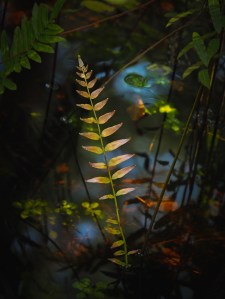
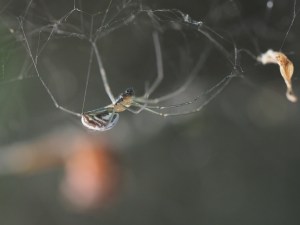
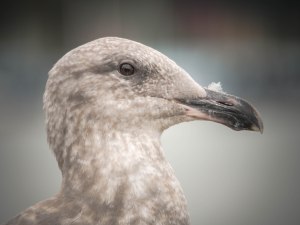
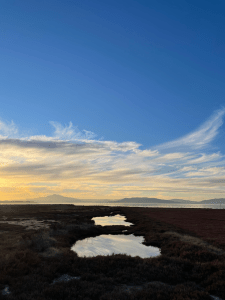
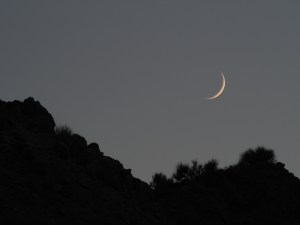
T.K.: I actually love nature photography and wish I had more time for it. (I’ll attach a few faves) [note from Myna: check out the alt text for info on each of these gorgeous photos!]
Myna: What do you wish I’d asked?
T.K.: The Wildcraft Drones has a few illustrations in it — what’s the deal with those?
I’m a very visual thinker, and some concepts just work better as images. I enjoy drawing and don’t suck at it, so I proposed the idea to my publisher. She was into it, so I got to make a few standalone visual vignettes for the collection. I’ll be selling prints of some of them on my website soon!
Myna: What’s next for you?
T.K.: Lots of events this year to promote the book, check out my website for the full list! tkrex.wtf
***
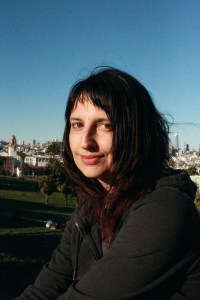
T.K. Rex is a Pushcart-nominated science fiction and fantasy author from the western states, whose stories can be read in numerous publications, including their debut collection, The Wildcraft Drones, available May 21, 2026. They’re an alumni of the Clarion, Taos Toolbox and Futurescapes workshops; a member of the Science Fiction & Fantasy Writers Association, the Authors Guild, and the Writers Grotto; and the co-host of Stir, a seasonal reading series in San Francisco. T. K.’s newsletter, interviews, and book tour dates can be found at tkrex.wtf.
Find T.K. on Bluesky or Instagram
Preorder The Wildcraft Drones on bookshop.org

