
My friends know I’m a contest addict, and the NYC Midnight competitions are my drug of choice. I love the excitement of waiting up for my prompts, then panicking about them with my contest buddies. Seeing how different writers interpret the same set of prompts is endlessly fascinating.
My first contest was the Flash Fiction Challenge in 2017. Since then, I’ve written 70 competition stories, ranging in length from 100 words to 2500 words, across 17 genres. Many of those stories have gone on to publication (with plenty of editing!) in professional and semi-pro markets, anthologies, and my own flash collection.
I’ve learned a lot about writing in different genres, and even won some money along the way. Most importantly, I’ve met a big group of writers and developed many long-term friendships. It’s amazing to realize I’ve been writing alongside these folks for a decade now. The robust network of NYC Midnight writers is (to me) both surprising and inspiring.
So, I was thrilled when Competition Director Charlie Weisman agreed to answer my questions. Huge thanks to Charlie for creating this fantastic contest, and for keeping it going so smoothly!
***
Myna: Give us a quick intro to NYC Midnight.
Charlie: NYC Midnight offers a variety of competitions throughout the year which challenge participants to create short stories and screenplays based on three prompts which can consist of a genre, action, character, emotion, location, object, word, or subject/theme. Writers have anywhere from 24 hours to eight days to complete the submissions. Currently NYC Midnight hosts the 100-word Microfiction Challenge, 250-word Microfiction Challenge, 500-word Fiction Challenge, Flash Fiction Challenge, Rhyming Story Challenge, Scary Story Challenge, Screenwriting Challenge, and Short Story Challenge. Writers receive constructive feedback from the judges on every submission and retain all the rights to the work they create in the challenges.
Myna: What makes NYC Midnight unique in the contest world?
Charlie: I would say the first thing that makes NYC Midnight unique in the contest world is that we’ve been doing this since way back in 2002. The name ‘NYC Midnight’ came from our very first competition, NYC Midnight Movie Making Madness, which challenged filmmakers in NYC to create short films from scratch in 24 hours, from midnight to midnight.
The Screenwriting and Short Story Challenges came soon after, and we’ve continued adding new challenges every few years. We’ve hosted hundreds of competitions and have evolved over the years by not only seeing what worked and didn’t work, but also by taking in all the great feedback from our participants, some who’ve been with us since our early days.
Another aspect which makes us unique is that each competition has multiple rounds of writing to determine the winners. So, a writer who does well may end up writing several stories in different genres throughout the competition.
Myna: How are the prompts generated? Is there an effort to provide prompts that might work well together? Do specific prompts cycle out of use from one contest to the next? Do entrants ever email to ask, “Please don’t ever give me toilet plunger or breast milk again?”
Charlie: I have creative people who help brainstorm prompts, but I still choose all the combinations that are assigned to the writers even though I know it’s micromanaging. I try to find combinations that have potential for a variety of interesting plots, though I’m aware that some combos are tougher than others. The good thing is that writers only compete against other participants who receive the same exact prompts, so everyone is in the same boat.
We are closing in on 10,000 different prompt combinations for our challenges, so some prompts are used repeatedly. But, if assigning a previously used prompt, then I try to make sure it’s been a few years and that it’s paired with a different genre.
Apologies to anyone who is assigned breast milk more than once, but rest assured it won’t be in the Ghost Story (2017) or Sci-Fi (2020) genres 🙂
Myna: How did the private forum come about? What can a new entrant expect to find there?
Charlie: We’ve had a forum since way back in 2002 with the first filmmaking competition. It was first meant to be a place where participants could chat with each other and find crew for their film, but the peer review aspect of the forums developed organically. Writers in the early competitions would share their stories on the forums and exchange feedback, and we eventually started creating separate, private forums for each of the challenges.
New entrants can expect a friendly community filled with writers of all different levels, and many who have been participating for well over a decade. Many people don’t share their stories in the peer review forums, but I do think it’s a valuable experience for the ones who do by getting to practice evaluating the writing from other participants and receiving a slew of different perspectives on their own story.
I’m also very aware that the forum is old-school and could be a smoother experience for the writers, and an upgrade is in the works.
Myna: Can you tell us how the stories are judged? Where do the judges come from? Is there training or a guideline to help them do their jobs?
Charlie: We use Submittable for the judging process. Three judges are assigned to each group in the early rounds, and five judges are used in the final round. Each judge needs to complete a rubric and review form in Submittable for each submission, and then we use the average score from all the judges to determine the rankings of the stories within each group.
We have a lot of great judges who have been with us for a while, but we also recruit through LinkedIn and are always open to anyone with experience in the field who is also enthusiastic about helping writers improve their craft. We have an online application that asks for sample feedback and relevant experience, and we invite people to become judges who appear to be a good fit. We’ve used thousands of judges over the years, but there are several hundred currently on our roster who we use on a regular basis. We pay all our judges and raise the rates each year to make sure they are fairly compensated for their time.
We do have a guideline that we provide to judges before each round which goes over the prompts and when to flag a submission for disqualification, recommendations for providing helpful feedback, and many other details regarding the judging process. We also have someone reviewing every judge, every round, to determine the likelihood of AI use (which we don’t allow) and to evaluate the helpfulness of their feedback to the writers. If their feedback isn’t where we want it, someone reaches out with detailed notes on what could be improved. We also allow the writers to evaluate the judges based on how helpful they find the feedback, and the participant rating is one of the most important numbers we look at when deciding which judges to use in future competitions.
Myna: What can a new entrant expect in terms of feedback from the judges?
Charlie: We ask the judges to provide several sentences of what they liked about the submission and what could be improved. With three judges reviewing each submission, participants typically receive several paragraphs (500 to 1,000 words) of feedback for each submission. In the final round, it’s typically double the length of the earlier rounds.
Myna: The number of participants, as well as the types of contests offered, has grown in the years since I first entered. What has driven this growth? Is it sustainable, or do you think you’ll hit a limit at some point?
Charlie: Yes, NYC Midnight has definitely grown. Our first Short Story Challenge had 205 writers, and this year’s challenge had over 5,000. Our high-water mark was in 2020 with over 7,600 participating in the first 100-word Microfiction Challenge, but a big part of that was people being stuck at home during the COVID lockdowns. I don’t know if we’ll ever hit those numbers again, but I would be completely fine with that if it means no more lockdowns.
Another reason we may never get back to those numbers is that there have been a lot of similar competitions popping up recently. But, it’s good to have competition, and it keeps us on our toes. I still have some fun ideas, so there may be a few more new challenges on the horizon.
Myna: Can you tell us about some of the technical challenges involved in administering the contest? How do you stay on top of everything?
Charlie: Yes, there are plenty of technical challenges that require a lot of different spreadsheets and databases. The most difficult task is coordinating the judging each round, making sure all the submissions are assigned, and deadlines are met. Life happens, so sometimes multiple judges drop out close to a deadline and replacements have to be found. Hundreds of stories flagged for disqualification also have to be reviewed.
Trying to make sure the writers and the judges aren’t using AI is a major challenge which didn’t exist until a few years ago, so it’s added a degree of difficulty to the entire process.
The technology is advancing so rapidly it’s scary. I could go on and on about how against it I am, but I will just summarize by saying I think the potential negatives far outweigh any potential positives promised by the megalomaniacs developing it.
Myna: How many people work for NYC Midnight? What roles do they fill?
Charlie: In addition to the hundreds of judges, there are a handful of talented people helping out behind the scenes doing various tasks like answering emails, social media posts, reviewing feedback from the judges, going through ratings from the participants and addressing with the judges, reviewing disqualifications, brainstorming prompts, updating the website, sponsorships, and more.
Myna: Tell us about your role. What do you do? What takes the most time? What is your favorite part of this job?
Charlie: Most of my time is spent coordinating the judging, but as any small business owner knows, there are always a hundred different things that need to be done. Seeing the amazing stories and screenplays that come out of the challenges and hearing from participants who have been inspired by the competitions is definitely my favorite part of the job.
Myna: Were there any surprises or problems along the route to establishing NYC Midnight?
Charlie: Yes, it’s been a learning experience from day one. The filmmaking competitions had the most stressful surprises, from projectors dying in the middle of screenings to editors disappearing with our only copies of the films, and more in between. The writing challenges have had their fair share of issues too, like the website going down at midnight when thousands of people were trying to find their prompts and judges dropping out at the last minute.
It’s all part of running a competition, and it would be pretty boring without a few surprises here and there.
Myna: Tell us about your career trajectory. How did you get here?
Charlie: I always had a love for creative writing and film, but I somehow ended up becoming a civil engineer. I worked in Boston and New York on some big construction projects and met a lot of good people, but I really didn’t like it. One of the construction projects I worked on was the Westside Highway in lower Manhattan, and it was close to the Twin Towers. I remember watching them fall on 9/11 and being in the city during that time when everyone seemed to come together to try and help however they could.
It was a powerful reminder that life is short, and I decided to get back to doing things that I loved.
I started taking evening filmmaking classes in NYC while I was still working as an engineer, which led to the crazy idea of creating a midnight-to-midnight filmmaking competition, and NYC Midnight was born. There was a blackout across the Northeast in August 2003, and I remember walking across the Brooklyn Bridge late at night after being stuck at work, the entire city was dark, and I decided to quit my job the next day to run NYC Midnight full time. I had no idea what I was doing, but I’ve been stubborn enough to keep at it over the years through all the ups and downs, and I really do enjoy it. But it’s getting a lot harder to stay up past midnight these days 🙂
Myna: Do you also write? Tell us about your creative endeavors!
Charlie: Unfortunately, I don’t write creatively too much these days. I have a lot of ideas, but no time at the moment. It would be nice to enter a challenge someday, rather than running them.
Myna: Do you have a pet or other hobby/activity?
Charlie: I’m currently into skiing with my two daughters, surfing, soccer, and trying to stay politically active. We also have a goldfish that seems to be doubling in size every few weeks.
Myna: What’s next for NYC Midnight? For you?
Charlie: I’ve had a concept to showcase more of the top stories from our challenges for many years now, and it’s finally close to becoming a reality. I hope to announce it soon, so stay tuned to our newsletter. Thank you for being a long-time participant, Myna, and for thinking of me for the interview!
***
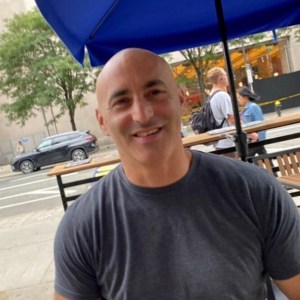
Outside of running NYC Midnight, Charlie enjoys spending time with his wife and two daughters, ranting against AI, and trying to spend as much time outdoors as possible.
Follow NYC Midnight on Bluesky / Facebook / Instagram / LinkedIn / Twitter
And check out the contest specifics, including craft tips and winning stories, at the competition website.

 Myna Chang