
I love A.D. Sui’s writing, so I was excited to hear the audio version of The Iron Garden Sutra. The publisher, Erewhon Books, describes the novel as a “darkly philosophical murder mystery, as a death monk and a team of researchers trapped onboard a spaceship of the dead encounter something beyond human understanding.”
The story is atmospheric—such lush worldbuilding!—and bursting with tension at every turn. I felt the protagonist’s claustrophobic anxiety throughout the story. The early conflict genuinely creeped me out. Layers of mystery unfold at a relaxed pace, which placed me firmly in the setting. And who could resist the opportunity to explore a thousand-year-dead generation ship?
I listened to the audiobook, which is narrated by T. Ryder Smith, in a soothing voice befitting our monk. Vessel Iris, accompanied by his integrated AI companion, have a distinct relationship. I think their vibe comes through nicely in the audio version. The book delves into complex emotional questions, so I imagine some folks would do better with the print or ebook version; some passages deserve a second read before moving on.
You can read the first chapter at Reactor.
Thanks to Erewhon Books and NetGalley for the audio ARC. And thanks to A.D. Sui for taking time to answer my questions!
***
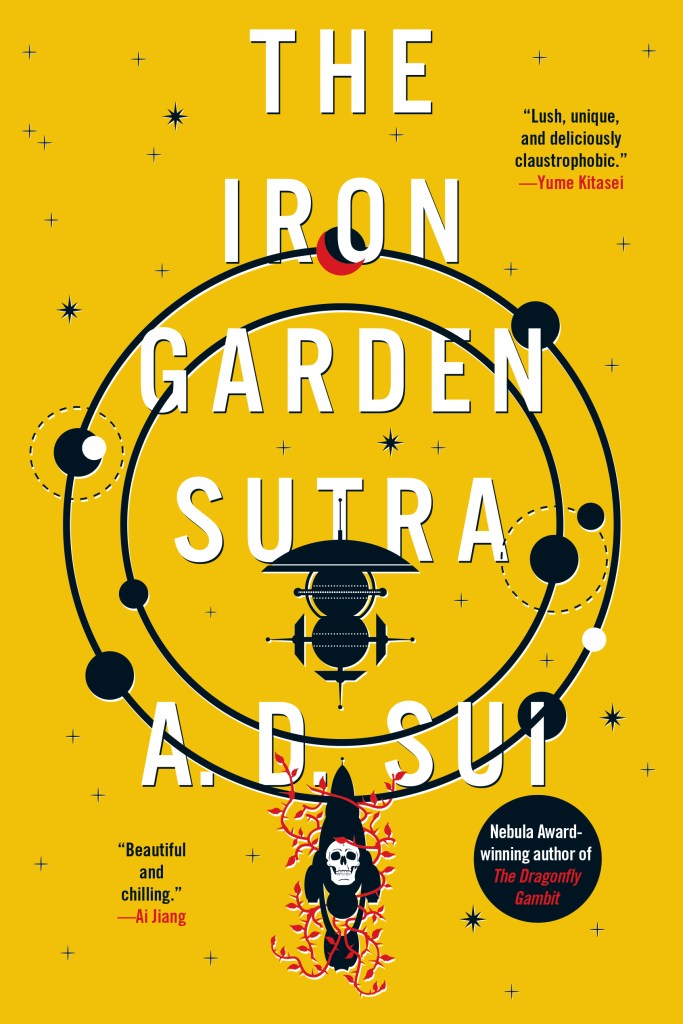
Original jacket concept by Sybille Sterk/ Arcangel Imagives
Cover design by Seth Lerner
Myna: Tell us about The Iron Garden Sutra! What’s it about? Who are your characters & what themes do you explore?
A.D.: The Iron Garden Sutra is about a socially anxious monk whose job it is to perform funeral rites for the dying and then prepare their bodies so that the families may collect them. He enjoys his job since he doesn’t need to interact with people much, and when he does, they tend to… well… they’re not around for long. At the beginning of the book, he gets assigned to a generation ship that’s just appeared out of deep space. Everyone aboard is dead and it would be good for someone to put them to rest. Except when he gets there, he realizes that a group of academics were also sent to the ship to explore it (since it’s of such historic importance). Then bad things begin to happen. Then, really bad things begin to happen.
As you can tell, this is not a light book. There are a lot of philosophical discussions about death and dying, and then these conversations get more practical in nature. I really wanted to explore what witnessing death does to a person. So, I took that idea to its natural conclusion. What if someone’s job was to observe death? What kind of person would they become? How would it impact all of their relationships?
Myna: I’ve enjoyed the audio version of your book. Did you have any input regarding the voice actor or production of the audio? How does it feel to hear someone else read your work?
A.D.: It’s both really cool and very uncomfortable to hear someone read my work out loud. It really highlights how important it is for the book to sound good on a sentence level. For example, I heard a passage that had too many “th” sounds. Did I read the whole thing, out loud, cover-to-cover? Yes. Did it only sound off to me when someone else read it? Also yes.
When it came to selecting the narrator, I was provided with three choices and then picked the one who had the most The Iron Garden Sutra “vibe”. I gave general notes about the atmosphere of the book and the characters’ manner of speaking and the narrator took it from there.
Myna: When a reader finishes the last word in the book, what emotion will they be feeling?
A.D.: Hopefully anticipation for the next one?
Honestly, I can’t be certain. Death is such a contentious topic, so I’m not sure how people will feel about the book as a whole. Early reviews have been coming in, and a lot of folks really enjoy it! So, I’m happy.
Myna: How did this book come about?
A.D.: Fun fact about the book: I started writing it on February 24th, 2022. It will be published on February 24th, 2026. Four years to the day!
I started writing The Iron Garden Sutra as I madly refreshed Twitter because the full-scale invasion of Ukraine had begun.
I needed updates. Kharkiv was getting hit, my home city. People were dying and others were livestreaming the dying. I had so much rage and fear and confusion in me and I needed to place it somewhere. So, onto a page it went. I needed to write a book about death, but I couldn’t write about the war because that was too close. I figured that if I could put Iris, my monk, through all this turmoil and he’d come out on the other end, then I could sort of use him as a template about how to wrap my head around what was happening.
Sorry, Iris.
Myna: Were there any surprises or problems along the route to writing or publishing The Iron Garden Sutra?
A.D.: The extent of plotting for this book were three lines on a post it note. I remember finishing the second act and looking at the final line: Iris figures it out. Okay, thank you past A.D., that’s very helpful. So, there were many evenings by the dinner table where I would just narrate my ideas to my partner, and he’d workshop plot points with me.
It was then that I realized that this had to be a duology, which was… a difficult sell. A duology? From a debut author? In science fiction? There was a while when I didn’t think it would sell in that form and I’d have to completely rewrite the ending so it made sense, but luckily my editor fought hard for me and it’s a duology!
Myna: How would you describe your writing style, in general? Does that hold true for this book?
A.D.: I draft fast, so most of my drafts take between a month and two months.
The Iron Garden Sutra draft took 3 months because I was finishing up my doctoral thesis, so I was writing the thesis in the mornings and the book in the evenings as a way to retain some sanity.
My writing process changes with each book. Some books I can go into without a plan. Others, demand a detailed plot. Some books need to be written chronologically. Others, I can write out of order. It really depends on the idea and the final shape I want for it to take.
My most recent WIP was something I’ve been munching on and playing with for a year. I didn’t know what the final story shape needed to be, so I kept moving things around, drafting scenes, researching stuff. And then, one day it just clicked and I cranked out 70k words in a month.
There’s always a moment when the story falls into place, when I understand what or who the story is about, and it’s rarely about what I thought it was about when I came up with it. Once it clicks though, it’s like the whole thing appears in my mind in its completed form, and then it’s just a matter of how fast I can type.
Myna: What’s your favorite thing about writing?
A.D.: Being someone else. Even if I’m not writing in first-person, I’m still filtering the story through a character’s eyes, and that’s a whole other life I get to experience. There’s no getting bored of that.
Myna: Do you have other books or stories you’d like to mention?
A.D.: Of course, we have The Dragonfly Gambit which came out in 2024 and won a Nebula!
This year I am most proud of Mavka, my short story about what we are willing to devour, physically and metaphorically, to survive. It was published in PseudoPod.
Myna: Tell us about your awards, nominations, etc. Don’t be shy!
A.D.: Last year I won a Nebula, which was wild. When my mother sent me a photo she took of the TV screen (my parents were watching the ceremony, I was not), I thought it was AI generated.
Myna: Would you rather live in a magical forest, an advanced urban high-rise, an enchanted underwater city, or a complex alien world? Or do you have another perfect living space in mind?
A.D.: I’d like to stay on this planet, but go back to Kerch, Crimea in 1997. I would have been six, climbing trees and picking apples. I saw my first dolphin that year (I probably saw them earlier, but was too young to remember). My grandparents’ apartment balcony had grape vines growing all over it and I swear, those were the best grapes I had ever tasted. Still are. I have no bad memories of Kerch.
If I could, I’d stay in that summer for as long as I can.
Myna: Do you have a pet, or other non-writing hobbies/activities? Show us a picture!
A.D.: I have two dogs of vastly different energy levels, which proves to be tricky when one dog is having a blast on a hike and the other dog is fighting for his dear life.
I also run! I’m not great at it, but I enjoy being outside and going places. Running helps me get places faster.
Myna: What’s next for you?
A.D.: I have a second book coming out in 2026! Our Infinite and Inevitable Ends comes out with ECW Press on October 27th, 2026. It’s a book about academia, psychedelics, complicated sapphic relationships, and a thinly veiled love letter to Toronto.
***
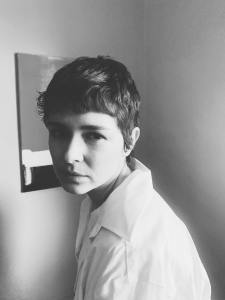
A.D. Sui is a Ukrainian-born, internationally raised speculative writer, Nebula winner, and Aurora, and Theodore Sturgeon Memorial Award finalist. They are the author of The Dragonfly Gambit (2024), The Iron Garden Sutra (2026), and more than two dozen short stories. A failed academic and retired fencer, they spend most days wrangling their two dogs and tending to their myriads of tropical plants. You can find them on most social media platforms as @thesuiway.
The Iron Garden Sutra can be purchased anywhere books are sold!

 Myna Chang