
I’m looking forward to reading The Bedtime Emptying of Our World, a new collection from Joel Hans. The book will be released by Moon City Press in February. I loved the title story when it appeared in Flash Frog, and after reading this interview, I cannot wait to dive in! Thanks to Joel for taking time to answer my questions!
***
Myna: The Bedtime Emptying of Our World is such an intriguing title! Tell us about the collection.
Joel: Thank you for the chance to talk a bit about this collection, which brings together twenty-two stories I wrote over roughly the last decade. These stories range quite widely in their lengths and underlying styles/genres, but they’re bound by a few common qualities: my deep love of fairy tales, my penchant for fabulism, and an endless exploration of parenthood in its many forms.
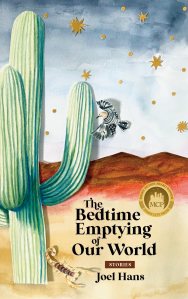
Cover art by Elisabeth Anderson Art & Design
I designed the collection with a certain inconsistency. There are long stories about Gila monsters with uplifted intelligence who struggle for years to develop the perfect crop (“Little Monsters of the Far Wood”), just as there are pieces of microfiction about leaving your family to become a hummingbird. Stories I wrote ten years ago nestled up against those I wrote just before wrapping up this collection. Stories about the worst losses we could imagine and stories I hope to inspire you to see your own world in new color.
I’ll write more about how this came to be later, but all these stories take place, in no particular order, across the history and development of a very unreal, very distant place called the Far Wood. This place might look and sound like the Sonoran Desert, and it might be populated by saguaro cacti and roadrunners and desert tortoises, but I hope that, as you explore these stories and the threads between them, you start to see a new mythos that underpins them all.
Myna: Do you have a favorite story or character in this collection?
Joel: I like to line my stories with memorable side characters, even if their only function is, like in a good fairy tale, to hand over a gift or push the narrative along.
To that end, Marbles, the talking beaver-coyote from “The Coup of Animal New,” has a special place in my heart. I even have a watercolor painting of Marbles in my office that I’ve treasured for a long time. If we’re sticking with humans, then I have deep affection for the birding-and-mountain-biking dad in “Two Decorated Skulls in the Miramonte Swamp” (hint: it’s me); the cookie-baking, toad-and-snake-speaking mother in “The Aunt of Everything,” and the servant from the kingdom across the street in “Thirty-One Functions for a Girl Living Inside an Apple.”
The latter is also the story I’m most proud of, too, in part because it took the longest to get right and out in the world.
Probably because I really allowed myself to experiment with form, prose style, metafiction, character development, and honest-to-goodness anti-narrative.
It’s a love letter to the motifs of fairy tales as much as it is the force that drove how the world these stories share truly works.
I wrote the first version of the story in 2015-ish during an MFA workshop with Kate Bernheimer. We read about Vladimir Propp’s concept of thirty-one “narratemes,” which are the building blocks behind almost all fairy tales both ancient and modern, and I felt compelled to break down a story into those functions in the most literal way possible. I got incredible feedback from the workshop and rushed to roll it all in and start submitting, sure I was bound to land a big-to-me journal… only for it to rack up a long list of “close, but not quite” rejections.
Jump eight-something years later: During a much-needed break from novel writing, I rediscovered the folder with all these drafts, read the most recent one, and found that, while flawed, the story still spoke to me. A few more drafts later and it was ready (once again) for to send out into the world. After another bout of close calls, Kate herself finally plucked the story from the Fairy Tale Review queue and gave it a home in 20th anniversary Arsenic Issue. A true homecoming and the truest delight as a writer.
Myna: When a reader finishes the last word in the book, what emotion will they be feeling?
Joel: I hope they feel welcomed into a world still modulating through its extremes, tragic and hopeful, chaotic and peaceful, as though the work of forging it is not yet done. I hope they’ve met a few characters along the way that won’t so quickly fall into the margins of their memories. I hope they feel a bit of hope.
Myna: How did this collection come about?
Joel: I struggled for 10 years to put together a collection. I’d written plenty of stories I was proud of and had then published them in some very fine journals, but all my attempts to thread them together lacked a certain cohesion. Maybe they were more dissimilar in tone and texture than I thought. Maybe they had come from different eras of my writing life—my life life—and that somehow showed in the aggregate. Maybe they just weren’t good enough.
That changed a few years ago, when I started working on “The Cirrus Circus,” which established the world of this collection: a desert planet its inhabitants call the Far Wood, which looks and reads much like the Sonoran Desert in which I live. A world that was terraformed and still needs weather; a world that is inhabited but lacks origin stories; a world that’s adopted impossible quests as a means of populating its own myths.
The choice to place everything after I wrote “The Cirrus Circus” in the same world was an easy one. I’m so enamored with the place I wrote a “spin-off” novel. But I still had all these older stories I knew were successful and meant the world to me. What about them? During my revisions of “Thirty-One Functions for a Girl Living Inside an Apple,” I realized I could reshape older stories to fit into this world, too, with some minor changes that no one likely cares about but me.
Suddenly, these stories weren’t just strange, but similarly strange. Once I had that, the rest fell into place.
Myna: If your collection had a theme song, what would it be?
Joel: A single theme song would be difficult for me to winnow down to, but I’d be willing to make a strongly educated guess that I listened to Beach House more than anything else while writing the aggregate of these stories. Dream pop pairs well with fairyland.
Myna: Did you find any surprises while writing these stories?
Joel: How long it would take.
Myna: How would you describe your writing style, in general? Does that hold true throughout this collection?
Joel: Overwrought? Ornate? A tad over the top?
I’ve heard from editors, agents, writer friends, and even members of my own family that my writing style errs on the side of dense or hard to follow. I’ve also tallied up plenty of beautifuls and gorgeouses and evocatives along the way, too, so I’m happily willing to admit that it is, in its best shape, an acquired taste.
I’ve also had the gatekeeper-y folks tell me that if a short story or novel I’d written was, you know, just written differently, they would’ve taken it more seriously or championed it at the next of many gates for it to pass through. I kowtowed for one novel in a more marketable style, but in the end, maybe I hadn’t changed enough. Maybe it wasn’t the style after all. Maybe I couldn’t stop the way I love to write from bleeding through.
In the end, I care deeply about language.
I find joy in the happenstance of a sentence, pairing together words that truly don’t belong, plucking a word out from antiquity and using it in an illogical way just because it sounds right and you don’t know the word anyway so you can’t tell me I’m doing it wrong. A touch of good dissonance means I’m onto something. Tossing in extra commas or trying to box them all out is a game I could play forever.
Trying, with style, is large part of what brings me back to the page.
Myna: What’s your favorite thing about writing?
Joel: Starting with a very out-there premise and writing my way, searching and spiraling and starting over, into the emotion and characters that’ll be the heart of the story.
Once I have that, it’s a matter of playing with language.
Myna: I imagine readers would love to hear about the literary journal you publish, Astrolabe. It’s such a cool concept! Tell us about the journal—what makes it unique?
Joel: Astrolabe attempts to twist the standard “shape” of an online literary magazine into a canvas you’re meant to explore non-linearly.
Instead of issues, we have asterisms: Clepsydra, Stitches, Errants, Conch. Instead of a rolling list of recently published works, like a blog, we have a two-dimensional “universe” visualization that you pan, zoom, and click through.
Jae Towle, a phenomenal writer and one of my peers at the University of Arizona MFA, and I dreamed up the conceit years ago and I exhausted every fiber of web development skills I have to make the visualization serviceable. We’ve been running it for three years now, and have since brought on Astrid Liu, a non-fiction writer who passed through the same MFA a few years after us, to bring in fresh perspective.
I’d love if you checked it out! We also open for submissions on every solstice and equinox—roughly March 20, June 20, September 20, and December 20—and pay a $50 honorarium to everyone we publish.
Myna: What’s next for you?
Joel: I’m always working on some novel. The current project also takes place in the Far Wood, like this collection, just further along in its history. Hundreds of years after these stories, a young girl gets an impossible quest: complete the last impossible quest the Far Wood will ever know. I finished a second draft a few months ago and hope to come back to it for another clean-up round or two later this year.
But publishing this collection has also reminded me of my love for the short story. It’s what got me into writing and remains, to me, the purest way to express what I love about the art: the motifs, the margins, the language. I have a half-dozen concepts for longer short stories and a novella I can’t wait to put to the page this year. I can only hope, as finally came to pass with this collection, that you’ll be able to find them out in the world someday.
***
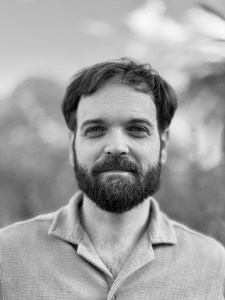
Joel Hans is the author of the collection THE BEDTIME EMPTYING OF OUR WORLD, winner of the 2025 Moon City Short Fiction Award. His fiction appears in Story, Fairy Tale Review, West Branch, The Journal, Booth, and others, and has been anthologized in Best Small Fictions. Find him in Tucson, Arizona, where he lives with his family, or at joelhans.com.
Find Joel on Bluesky and Instagram

 Myna Chang