I’m a long-time fan of Jason Sanford’s Genre Grapevine column, and I loved his novel, Plague Birds. I’m excited to read his new novella, We Who Hunt Alexanders, recently released by Apex Books. Huge thanks to Jason for answering my questions!
***
Myna: Tell us about your novella, We Who Hunt Alexanders! What’s it about and who are your characters?
Jason: We Who Hunt Alexanders is about a young neurodiverse monster named Amelia who’s a ripper, a type of monster that feeds on violent people who have so abandoned love they’ve burned away their souls. The only emotion most rippers feel is anger. But Amelia is different because she also feels happiness, sadness, fear, love and every other emotion. To Amelia’s mother, that marks her as dangerously different.
To stay alive, Amelia must learn if her differences from her fellow rippers make her weak, as her mother believes, or if she can instead be a new kind of monster that the world has never seen before.

Cover art by Asya Yordanova
Myna: What themes do you explore?
Jason: Amelia’s story is set in a gothic, 19th century city where violent people kill anyone who oppose them. But the book’s themes are also very familiar to anyone living in today’s world, including how the rich and powerful use the threat of violence to force others to submit to their will. The novella also explores the idea of found families and how community, family and friendships not only help people survive in dangerous times but keep hope alive in our hearts.
My favorite reaction to We Who Hunt Alexanders is when people call it a “cozy horror,” a description I think fits really well.
Myna: What’s unique about this book?
Jason: The book is neurodiverse as hell. As someone who is on the spectrum and has ADHD, I’ve long written about neurodiverse characters and topics. However, this novella is the first time I’ve written so openly about all this.
Myna: When a reader finishes the last word in the book, what emotion will they be feeling?
Jason: Hope. Definitely hope. In fact, when I sign copies of this book I always add the inscription “Keep fighting and keep hope alive.” I believe that message is sorely needed not only in Amelia’s world but also in our own.
Myna: How did this novella come about?
Jason: We Who Hunt Alexanders is very much a reaction to what I’m seeing happen in today’s world. From big issues like hate, intolerance, anger, and political violence to specific issues like book burnings, this story was my personal scream against so much of what’s going on today.
Myna: What’s your favorite thing about writing?
Jason: I believe in the power of stories to change the world. To a large degree, humans see and understand the world through stories. And when you create your own stories and share them with the world, you help change not only yourself but also other people. And that can change the larger world in amazing ways.
I also love how my writing helps connect me to the larger world. And you never know when or how your stories may inspire others and lead them to create their own stories.
Myna: Tell us about a recent accomplishment or share some happy news with us!
Jason: I was a finalist this year for the Hugo Award for Best Fan Writer and the Hugo Award for Best Related Work. In addition to my fiction writing, I’m also a journalist who reports on the science fiction and fantasy genre through my Genre Grapevine column. While I didn’t win, it was an honor and joy to be a finalist for both Hugos.
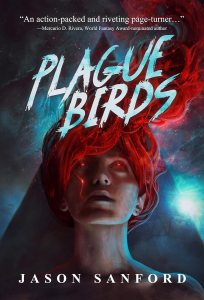
Cover art by Marcela Bolívar
Myna: Your novel, Plague Birds, explores several exciting concepts. Please tell us more about it!
Jason: Plague Birds is set in the far future – so far from our own times that the story almost reads like dark fantasy even through it’s pure science fiction. In this distant future, society has collapsed. The survivors include both genetically altered humans and powerful artificial intelligences, all of whom live alongside each other as they try to rebuild civilization.
Overseeing all this are plague birds, the feared merging of humans and artificial intelligences who serve as the world’s judges and executioners. The story focuses on a young woman named Crista, who is forced to leave her home village and become one of these hated plague birds.
Plague Birds was a finalist a few years back for the Philip K. Dick Award and the Nebula Award for Best Novel. And in some good news, I’m working on a sequel to the novel, which should be published next year.
Myna: Tell us about your awards, nominations, etc. Don’t be shy!
Jason: One of my most read and reprinted short stories is “The Eight-Thousanders,” which was originally published in Asimov’s Science Fiction. The story examines the ethical issues surrounding mountain climbing and the destructive “tech bro” attitudes that are dominating our world.
All of which sounds boring, so here’s the exciting part: Vampire hunts down entitled tech bros climbing Mount Everest!
The story ended up being a finalist for the Nebula Award and was longlisted for the Hugo Award. It’s also been translated into a number of languages including Spanish and Japanese.
Myna: What’s next for you?
Jason: I’m finishing work on a new novel, and then I need to complete work on the sequel to Plague Birds. I also have a novella I’m working on along with various short stories.
***

Jason Sanford is an award-winning science fiction and fantasy writer who’s also a passionate advocate for fellow authors, creators, and fans, in particular through reporting in his Genre Grapevine column (for which he’s been a finalist multiple times for the Hugo Award for Best Fan Writer). He’s also published dozens of stories in magazines such as Asimov’s Science Fiction, Interzone, and Beneath Ceaseless Skies along with appearances in various “year’s best” anthologies and The New Voices of Science Fiction. His first novel Plague Birds was a finalist for both the 2022 Nebula Award and the 2022 Philip K. Dick Award. Born and raised in the American South, Jason’s previous experience includes work as an archaeologist, journalist and a Peace Corps Volunteer. His website is www.jasonsanford.com.

 Myna Chang