
I met Erin Cairns through a writers’ group, which led me to her phenomenal speculative fiction aggregator, InkFoundry. She’s also a writer and editor, and she creates gorgeous art. Huge thanks to Erin for answering my questions!
***
Myna: Tell us about InkFoundry! What can we expect to find there?
Erin: You’ll find an archive! InkFoundry is a digital index of original, free-to-read short stories created to help readers access and discover new stories and authors. The stories are archived by attributes such as their length, their genre, and even by catalogues that readers can widen or narrow so they can binge-read stories about hive-minds and then expand to stories about telepathy, or swap over to fae folk and find a collection of stories containing every kind of fairy, elf, and goblin at once.
You can also filter all of these alongside other tags like ‘cute’, ‘sad’, ‘happy ending’, or ‘dark’—there’s even an option to filter by audiobooks!
Myna: What inspired you to create InkFoundry?
Erin: Strangely enough, it was fanfiction. I was going through a tough time when I created InkFoundry, and reading, which always used to comfort me, was taking so much energy.
Usually when reading short fiction, I rely on being caught by the title, author, or the premise/tone of the magazine. That’s not a lot to go on and I used to take extended breaks from reading short fiction because I’d often get ambushed by tragedy or hard truths. Of course, it is so important to be exposed to those things, but it also means that readers are coming in with shields up instead of excited about this particular story because they are excited about its premise or promise.
Enter: fanfiction! I read pretty much every kind of fiction—books, graphic novels, short stories, poetry, picture books—I’m not joking, I read everything, and I enjoy every kind of medium and storytelling, but fanfiction is easy to jump in and out of. A large part of that is coming into a familiar world already invested in characters and story, but the delivery mechanism, the way that fanfiction is tagged and curated is just so fantastically accessible. I find it energizing to go wiki-walking through increasingly bizarre tags and tropes, into completely unfamiliar fandoms.
I think original fiction is so ready for that kind of accessibility. I want to see unfamiliar tags, and get excited by crazy intriguing tropes and ideas like ‘animatronic walrus’ (Headhunting by Rich Larson) and ‘fairy god-triceratops’ (Maiasaura Deifaeria by Jennifer Lee Rossman) and ‘oops, I saved the world and my evil overlord is going to be soooo mad’ (I haven’t found this one yet, but I’m sure it’s out there).
And as I created InkFoundry and started reading stories to tag them, to recommend them and index them, it was like I found my old escape hatch again. I am constantly delighted and re-inspired by the stories I read.

Inky the Catalogtapus
Myna: What are you looking for when choosing stories for inclusion?
Erin: If I can finish a story, I add it to the archive even if I don’t enjoy the premise or the characters. This is partly because my focus is building the archive, but mostly because I know my taste isn’t everyone’s, and someone will likely enjoy the story even if I didn’t. After all, the stories I’m reading come from paying magazines and have been valued by the author and a series of editors and publishers—people who support the authors and stories with their own time and money.
I’m not a picky reader. I finished some stories purely out of morbid curiosity, and I still added them because… well… they did manage to keep my attention. Like The Moby Clitoris of His Beloved by Ian Watson and Roberto Quaglia, or Catch ‘Em in the Act by Terry Bisson.
That being said, I do choose stories for the ‘best of’ collections on InkFoundry and I have pretty high bars for those, and probably a great deal of personal bias. The stories must be strongly associated with the particular ‘best of’ tag (found family, happy endings, overcoming fear, etc.), and they have to be satisfying. They don’t have to end happily, or have a moral, but they do have to leave me feeling like a cat waking up in a sunspot—like I’m more complete leaving the story than I felt coming into it.
I’m not sure how to better articulate that, but every kind of genre and tag can give you that sauna-to-snowstorm or snowstorm-to-sauna feeling. It’s not about the conflict, character development, or the scale of the story. It could be about the choice between making peach cookies or peach ice cream (The Ghost Peach Pet Rescue by Eden Royce) or a hacker building clay golems to help a budding rebellion mess with the facial recognition software she helped design ( (emet) by Lauren Ring). There is just no limit you can put on taste.
Myna: Did you encounter any surprises or problems while creating InkFoundry? Is it difficult to maintain the site? Are there any ongoing challenges?
Erin: What surprised me most was how wide the gap I was trying to cross was. I thought the idea of InkFoundry would make instant sense to readers and authors, but sometimes it felt like trying to get two magnets to touch. In the fanfiction community, there’s a kind of trust between author and reader that I didn’t even realize existed when I started this project. For instance, I tagged Delilah S. Dawson’s story “Catcall” with the tag ‘misogyny’ without question or hesitation because it’s about how a young girl deals with misogyny and how it warps her. But a couple of my writer friends thought I was saying the story was misogynistic. It blew my mind! It felt like such an inside-out way of thinking about tags! Even when I put a warning on a story, it’s with the hope that it encourages a reader to click through and read it. Using tags to discourage the story or author is such a backwards concept to me.
And in that way, I think InkFoundry is skewed towards a community that doesn’t quite exist yet. I’ve built a tool that gets more effective with use, so it will be a little unwieldy until it finds more users. There are tags like ‘casefic’ (‘a short mystery that’s introduced and solved by a character who seems to specialize in solving other such short mysteries’) that I’ve had to borrow from fanfiction (Where it’s used in a more ‘case of the week’ context) because a more suitable word either doesn’t exist or hasn’t occurred to me yet. Another case of this is the ‘happy ending’ tag, which at least half a dozen people have told me sounds sexual. One day, hopefully, there will be a community of short story readers that will coin and define these terms more organically and make the stories they describe more discoverable. Unfortunately, until then, InkFoundry’s fledgling audience will be dealing with my rather specific brand of neurospice.
But that being said, the tag-wrangling is exactly my type of fun. There are so many times when I just start a debate at a table with a question like: “Do you think the ‘Schrödinger’s Cat’ tag should go under physics or philosophy?”
More specifically for the site… it started on Squarespace because I was just testing out the idea as a reading diary/test-of-concept. I got so frustrated by the limitations of Squarespace that learning webdev and building the whole thing myself actually felt like the easier option. It is a lot of work to maintain right now because I’m running it alone on a shoestring, but I believe in what I’m doing—that this is an important way to connect readers, writers, and publishers.
Myna: How do you fund the site?
Erin: The site is entirely funded by me. I have an absolutely visceral hatred of targeted ads, but I do want the site to be self-sustaining at some point, so I plan on getting a Patreon together. I’m trying to do my research and see what promises I can make or perks I can offer to patrons, so if someone else sees the vision and would like to support the work, stay tuned!
Myna: Can readers/writers help with the workload?
Erin: Absolutely! Go forth and read! Explore the archive, find a new story you like, and tell other readers about it! Shout tag ideas at me on Bluesky! Become a bounty hunter and add to the archive yourself! The form on the “Add a Story” page is up and working—just read the rules at the top and fill in the form!
Myna: How can writers get their stories listed?
Erin: There are really only 2 rules—you must have been paid for your story, (even token payment counts) and the story must be free-to-read upon landing. I’d recommend exploring InkFoundry before you add your stories to see if there are any tags that fit your story, but adding your own is completely fine!
Myna: What steps does a reader take when searching for a specific type of story?
Erin: There are a few different ways to find stories! On the main page, you can filter stories by tropes—it’s almost like ordering a story from a menu. For instance, choosing ‘Fantasy’ + ‘happy ending’ + ‘revenge’ + ‘talking animals’ in the filter will pull up “The Small God of West 54th St.” by Alex Kingsley.
Or you can visit the ‘Tags’ page under the Browse header to find archives of specific devices or tropes like ‘knitting’, ‘cartographers’, or ‘hurt/comfort’
If you already like a story on InkFoundry, you can click on its tags to bring up catalogues of a trope you liked, or see if it has any ‘similar stories’ by clicking its crest and scrolling to the bottom of its listing page.
Myna: Now let’s talk about your own writing! What sorts of stories do you write? Are there any themes you especially like to explore?
Erin: Ooo, yesss. I write character-driven stories, and there’s a common thread in most of my work about people challenging their perceptions, especially what they’ve been told about the world and their place in it. That leap of faith from comfortable, solid ground to the possibility of being wrong now, or accepting that everything was wrong before, and choosing to change—that works its way into pretty much everything I write.
Also, robots. I frickin’ love robots.
Myna: I’d love to hear about your novels!
Erin: I’ve got a couple! The Uncanny Valley and its soon-to-be-released sequel No Man’s Land are about very cool robots and very uncool cops. Mind the content warnings! You can read the first chapter for free on my website, erincairns.com.

The Uncanny Valley: Illustration and design by Kyna Tek
The Holofriend is a murder mystery set in the same world, and it’s about what happens when technology keeps us from having our perceptions challenged.

The Holofriend: Photo by cookie-studio, Design by Erin Cairns
And I’m querying Technomancer: A Feral Prophecy, the first book in a far-flung solarpunk epic about biker-gangs with a trust-based economy and their war against a bunch of gothic fascists!
Myna: Your art is so much fun! Can you tell us about your projects?
Erin: Booknooks:
I love miniatures. My mum made me dollhouses out of orange crates when I was a kid. Pretty much every hobby I picked up since has been geared towards miniatures—probably because making miniatures can stretch out your art supplies (Up until you get into Warhammer, in which case… your budget stretches pretty thin pretty quick). Still, I didn’t know what I was aiming for until I saw the Thorne Collection in the Chicago Art Institute. It’s a permanent collection of miniature rooms, and if you’re ever in Chicago, go. It’s gorgeous and magical, and no photograph can do it justice.
In 2016, I started making booknooks. They’ve improved over the years as I’ve picked up more tools, materials, and practice, and now I occasionally give them to charity auctions, which I announce on my website and Bluesky.
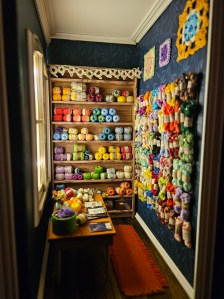
“The Yarn Shop” was originally made for my mum, who is an absolute mathematician-wizard with crochet. She spends her free time decoding ancient patterns and making me increasingly impressive garments.

“This is Not a Place of Honor”—a booknook inspired by the short story of the same name, by Alex Kingsley. It was the first story I’d ever read in Radon Journal, and I vibed with it. I’d started making the booknook before Radon ran a contest for fan art and realized pretty late there was one, but that made it all the more fun. I even used some Warhammer pieces!
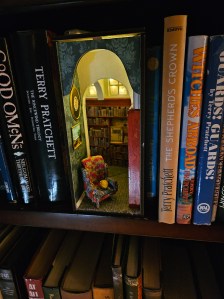
“The Comfortable Library” – An old design I’ve made quite a few times, but this is the smallest. My mum crocheted the miniature blanket, of course. 🙂
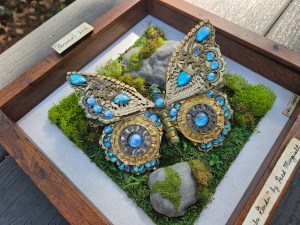
“The Scribes Garden” is not quite a book nook, but fan art I made for a story reprint I purchased for InkFoundry. It was released at a time I didn’t feel comfortable doing promo for the website, so it didn’t get the fanfare it deserved, but I made this fan art to display locally, with a QR code to where the story could be read.
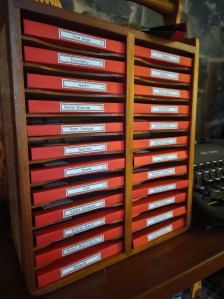

Indices:
I made these for the lobby of my local makerspace, to promote InkFoundry! Now I give special collections to friends and family as gifts. They’re physical ‘best of’ collections with QR codes that link to the stories. They’ve gone through a few iterations, but I’ve settled on this design—they’re the same dimensions as cassette tapes (so I can store and display them in old cassette boxes). So far I have 26 collections!. I’ll be taking the full set to Worldcon this year and giving away the ones that didn’t meet my quality assurance standards.
***
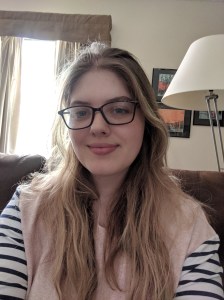
Erin Cairns is a writer, reader, and editor. She runs the speculative fiction aggregator site Inkfoundry.net, where she reads and wrangles short stories to encourage accessibility and discoverability for readers looking for a good narrative itch to scratch.
Her neon-noir mysteries, The Uncanny Valley and The Holofriend, are available at all ebook retailers, and her short fiction has previously been published in Writers of the Future Vol. 34, the Dark, and EscapePod.
You can see her past, current, and future projects at erincairns.com
Find Erin at Bluesky
Go to InkFoundry

 Myna Chang