Cardboard Spaceship, the new short story collection from Jean-Paul L. Garnier, is an engaging read. Stories are reminiscent of the Golden Age—but without that era’s problematic baggage. Garnier’s language is often lyrical, and the individual pieces range from lightly disturbing (seriously, “Phrogger” creeped me out!) to gee-whiz wonder to resonant stories suitable for literary flash magazines. The collection surfaces weird and frightening questions about humanity’s future, leaving much to ponder.
I’m grateful to Jean-Paul for taking time from his busy schedule to answer my questions!
***
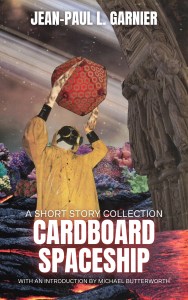
Myna: Tell us about your new collection, Cardboard Spaceship! That’s a wonderful title!
Jean-Paul: Thanks! The title is both a satire of the flimsy science found in SF, and a reference to my childhood when I would build spaceships out of cardboard and fantasize my own private space operas. Being an SF writer as an adult has allowed me to stay in that spaceship and to remain a child. The book contains 21 short stories that were written over the better part of a decade.
Myna: Are there any specific themes you explore with these stories?
Jean-Paul: The book is kind of all over the place, but some themes that are found throughout are: time travel, relationships, and miscommunication.
Myna: How did this collection come about?
Jean-Paul: The stories in the book were written over a period of many years, and most have them have appeared in magazines and anthologies, some appearing for the first time. When writing short fiction, I typically start with a premise and then try to let it flow, allowing myself to roll with the idea whether it might end up working or not. Failure is sometimes inevitable, but the inner censor must be killed.
Myna: What’s unique about this book?
Jean-Paul: It’s more than likely that I am a poet first and a writer of fiction second. Because of this my use of language often comes off as surprising to readers. But that being said, the book also features more conventional stories as well. When writing I am more concerned with emotional response to the text than sensual response. I am an aphant, so setting doesn’t mean that much to me, I am more concerned with the texture.
Myna: When a reader finishes the last word in the collection, what emotion will they be feeling?
Jean-Paul: Ultimately that is up to the reader, but I always hope that a sense of wonder is present, and that my distrust for consensus reality lingers in the reader’s mind.
Myna: If your book had a theme song, what would it be?
Jean-Paul: I have a complicated relationship with music, often suffering from misophonia. But this EP by Soisong comes to mind.
Myna: Were there any surprises or problems along the route to publishing?
Jean-Paul: When I first began writing SF full time, I was also submitting a lot, and naturally received tons of rejections. After being discouraged by this I decided to stop submitting for a few years and focus on refining my craft. I took classes, read books on writing, and spent a lot of time rewriting and letting go of being precious about my writing. This was the best move that I ever made, and when I reemerged, I found that my work was not only much better, but also started to get those desired acceptances.
Myna: How would you describe your writing style, in general? Does that hold true for this collection?
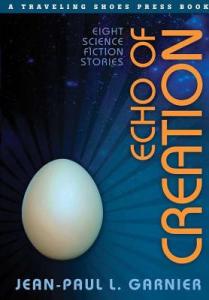
Jean-Paul: It really depends on what I’m writing. My last collection of short SF stories was much more traditional, campy, pulp SF. Cardboard Spaceship, in style, is much more related to the New Wave writers. Ballard and Disch are two of my favorites and have influenced me a lot, but also modern writers like Eugen Bacon, who are pushing the boundaries of what language can do. We often forget that language is also a technology, and this can be explored in SF.
Myna: Do you practice any special habits or routines in your writing process?
Jean-Paul: When I can write (in-between a million other tasks) I always write first thing in the morning, before I’ve spoken or encountered any stimuli. This allows my subconscious to remain active during the writing process. I also tend to write in longhand, which forces me to commit to what I’ve written and worry about editing later. It also forces me to do a rewrite, since the manuscript still needs to be typed. I try to write a minimum of 750 words a day, which tends to add up quickly.
Myna: Do you have a preferred genre, either to read or to write (or both)?
Jean-Paul: For reading, I read mostly SF and non-fiction. And I try to read as widely as possible, even about subjects that I don’t think will interest me. For writing, I write about whatever story keeps nagging at me. This leads me all over the place, from SF to westerns, to erotica. I’m definitely not one of those writers that sticks to a particular style or theme, and I enjoy being all over the place and following my interests.
Myna: What’s your favorite thing about writing?
Jean-Paul: Writing, especially SF, is a place of total freedom. I gravitated toward writing SF because it is the only field where you can actually break the laws of physics.
Myna: Tell us about a recent accomplishment or share some happy news with us!
Jean-Paul: This year has been incredible so far, and it’s been surprising to see a lot of my work recognized by our community. My podcast, Simultaneous Times, was a finalist for the BSFA award, and now the Ignyte and British Fantasy awards. The Simultaneous Times Vol.3 anthology that was released last year won best anthology for the Laureate award, the Next Generation Indie Book award, and the Critters Readers Poll. And I also won Best Editor for the Laureate award. It’s been overwhelming and humbling, and I have had no shortage of happy tears.
Myna: Have you published other books or stories you’d like to mention?
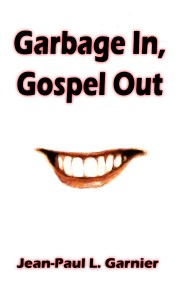
Jean-Paul: Yes, I published several books of SF and speculative poetry. Here’s a partial list:
Myna: Tell us about Space Cowboy Books!
Jean-Paul: Space Cowboy is my little bookstore in the Mojave Desert, which focuses on SF (but not exclusively). I opened the shop in December of 2015. It’s a dream come true and has blossomed into a publishing house, a podcast producer, event space, and more. It’s been an insane amount of work, but my life revolves around books and I wouldn’t have it any other way.
Myna: How do you get all these things done?! How do you stay motivated?
Jean-Paul: My method is to build mountains out of pebbles. Do a little something every day and eventually it builds up into something much grander. With so many things going on it can be overwhelming, but hey, if I could put up with working 40 hours a week for the man, then I can put in more hours than that to support and create art, and be free from what society expects of me.
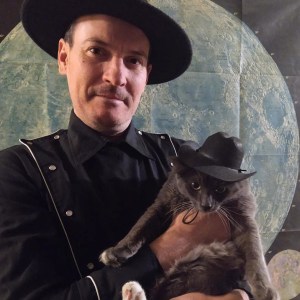
Myna: Do you have a pet, or other non-writing hobbies/activities? Show us a picture!
Jean-Paul: Yes, I have a precious little kitty named Dada. As for hobbies, I try to pick up something new to do with my hands every year. Often these are weird tactile things, my post-apocalyptic skills. They can vary from lock-picking, to my most recent endeavor making oil paint.
Myna: What’s next for you?
Jean-Paul: I have a western novella, Black Line Trail, coming out soon from Starlite Pulp, as part of a novella collection called American Muse. And I also have a gay SF erotica novella called In Each Other’s Arms, coming out in a collection called Cosmic Cage from Peter Schutes Publishing at the end of the year.
***

Jean-Paul L. Garnier is the owner of Space Cowboy Books bookstore and publishing house, producer of Simultaneous Times Podcast (2023 Laureate Award Winner, BSFA, Ignyte, and British Fantasy Award Finalist), and editor of the SFPA’s Star*Line magazine. He is also the deputy editor-in-chief of Worlds of IF & Galaxy magazines. In 2024 he won the Laureate Award for Best Editor. He has written many books of poetry and science fiction.
IG: https://www.instagram.com/spacecowboybooks/
Bluesky: https://bsky.app/profile/spacecowboybooks.bsky.social

 Myna Chang